The History and Evolution of the Classic American Hot Dog
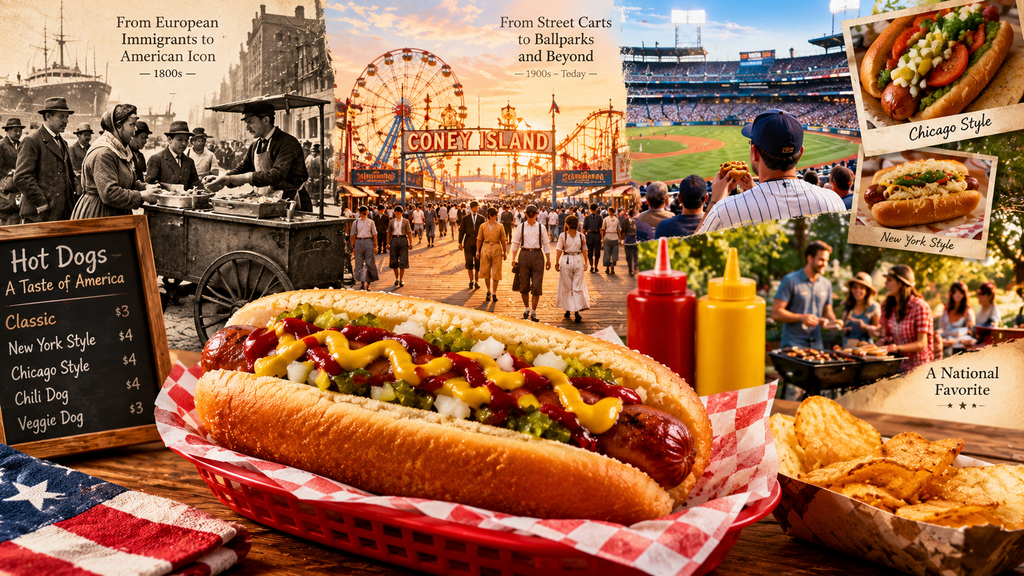
The classic American hot dog may look simple: a seasoned sausage placed inside a soft bun and finished with toppings. Yet behind this familiar handheld meal is a long story involving immigration, urbanization, street vending, food manufacturing, baseball, amusement parks, and regional identity. The hot dog is one of the clearest examples of how a food can arrive through migration, become adapted to local conditions, and eventually be recognized as a symbol of American everyday life.
Today, hot dogs appear at baseball games, summer cookouts, county fairs, roadside stands, convenience stores, diners, and family kitchens. Some are served with nothing more than mustard, while others are covered with chili, onions, relish, cheese, sauerkraut, or an elaborate combination of regional toppings. The hot dog’s evolution is not a straight line from one inventor to a finished product. It is a continuing process shaped by different communities, businesses, tastes, and cultural moments.
European Roots: The Arrival of Sausage Traditions
The story of the American hot dog begins with European sausage traditions. German-speaking communities had long prepared sausages such as frankfurters and wieners. These products were made from finely ground meat, seasoned with spices, and enclosed in casings. When German immigrants arrived in the United States in large numbers during the nineteenth century, they brought culinary knowledge, food preferences, and commercial skills with them.
The sausage was particularly suited to urban life. It could be cooked in batches, served quickly, and sold from small stands or carts. In growing American cities, workers and pedestrians needed inexpensive food that could be eaten without a formal dining room. Sausages met that need, especially when vendors began pairing them with bread or rolls.
It is important to distinguish between the European sausage and the modern American hot dog. The sausage itself had European precedents, but the hot dog as a portable food sold in a bun developed through American urban culture. The combination of product, presentation, price, and public setting helped create something recognizably new.
Street Vendors and the Rise of Portable Food
During the late nineteenth century, American cities experienced rapid population growth and expanding public entertainment. Street vendors sold food near factories, transportation hubs, markets, sporting events, and amusement destinations. Hot sausages were practical because they could be kept warm and served to customers in seconds.
Charles Feltman, a baker and vendor associated with Coney Island, is often credited with popularizing the sausage-in-a-bun format. Historical accounts differ over precise origins, and researchers caution that the hot dog’s early history includes competing claims and stories that are difficult to verify. Nevertheless, Coney Island became a major location in the hot dog’s development because its crowded boardwalks and amusement attractions created a large market for affordable handheld food.
The bun solved several practical problems. It allowed customers to hold a hot sausage without utensils, reduced the need for a plate, and made eating while walking much easier. The format also encouraged the use of condiments and toppings. A simple roll became a portable platform for mustard, onions, relish, ketchup, and regional variations.
How the Name “Hot Dog” Developed
The origin of the phrase “hot dog” is surrounded by popular stories, but no single explanation is universally accepted. One familiar legend claims that a cartoonist could not spell “dachshund” and labeled a sausage drawing “hot dog.” Historians have found no definitive evidence confirming that exact cartoon story.
The phrase appears in American usage by the late nineteenth century, including references connected to college life, sports, and food vendors. The name may have developed through humorous associations between long sausages and dachshund dogs, but its precise path remains uncertain. This uncertainty is a useful reminder that food history often contains marketing claims, newspaper jokes, oral traditions, and later myths alongside documented evidence.
Whatever its exact origin, the term became widely understood. “Hot dog” was shorter and more memorable than terms such as frankfurter or wienerwurst, helping the product move beyond specific immigrant communities into mainstream American commercial culture.
Coney Island and the American Entertainment Economy
Coney Island helped transform the hot dog into a food associated with leisure and entertainment. By the late nineteenth and early twentieth centuries, visitors came to the area for beaches, amusement rides, performances, and boardwalk attractions. They needed food that was inexpensive, quick, and easy to carry.
The hot dog fit perfectly into this environment. It could be eaten while walking between attractions or watching a crowd. The food became part of the sensory experience of the amusement park: the smell of cooked meat, the sound of vendors, the bright signs, and the movement of visitors along the boardwalk.
Nathan’s Famous, founded on Coney Island in 1916, later became one of the best-known names in American hot dog culture. The company’s history demonstrates how a small food stand could develop into a recognizable brand. It also shows the role of immigrant entrepreneurship in American food businesses. Nathan Handwerker, a Polish immigrant, helped build a business whose name became closely associated with the Coney Island hot dog.
Hot Dogs and Baseball
The relationship between hot dogs and baseball helped establish the food as an American cultural icon. Baseball stadiums offered a natural setting for handheld meals. Spectators could eat without leaving their seats, and vendors could move through the stands selling food to large crowds.
Over time, the hot dog became linked with the atmosphere of the ballpark: summer afternoons, team colors, cheering fans, scoreboards, and cold beverages. It was not necessarily the most sophisticated food available, but it was convenient, affordable, and emotionally connected to the experience of attending a game.
The baseball connection also helped spread the hot dog nationally. People who traveled to different cities encountered local versions, while stadium concessions created a consistent format that could be adapted to different markets. The hot dog became both a national symbol and a platform for regional variation.
Regional Styles Across the United States
One of the most interesting features of American hot dog culture is the number of regional styles. In New York, a hot dog may be served with mustard and sauerkraut or topped with cooked onions. Chicago-style hot dogs are commonly placed in a poppy-seed bun and topped with yellow mustard, chopped onions, bright green relish, a dill pickle spear, tomato, sport peppers, and celery salt. Traditional Chicago presentations typically avoid ketchup.
In Detroit, the Coney dog is often topped with chili, diced onions, and mustard. In the Southwest, hot dogs may be wrapped in bacon and finished with beans, onions, tomatoes, mayonnaise, and other toppings. New Jersey is known for variations involving deep-fried or grilled sausages, while regional chili dogs appear in many parts of the country with different spice blends and preparation methods.
These styles show that the hot dog is not a single fixed recipe. It is a flexible structure that allows communities to express local taste. Ingredients reflect regional agriculture, immigrant influence, restaurant competition, and customer expectations. A hot dog can therefore function as a culinary map of the United States.
Industrial Production and Food Standardization
The hot dog’s expansion was closely connected to industrial food production. Advances in meat processing, refrigeration, transportation, packaging, and retail distribution made sausages available to more consumers. Large manufacturers developed standardized products that could be sold across the country, while local butchers and independent vendors continued to produce distinctive versions.
Industrial production increased convenience, but it also raised questions about ingredients, food safety, labor, and transparency. Public concern about meatpacking conditions in the early twentieth century influenced how Americans viewed processed meat. Books, journalism, government regulation, and changing consumer expectations encouraged producers to improve sanitation and communicate more clearly about manufacturing practices.
Modern hot dogs can be made from beef, pork, chicken, turkey, mixed meats, or plant-based ingredients. They may be sold fresh, refrigerated, frozen, or shelf-stable depending on the product. This variety reflects the continuing interaction between technology, consumer demand, and food tradition.
The Hot Dog at Picnics, Cookouts, and Holidays
Beyond cities and stadiums, hot dogs became a staple of outdoor American gatherings. Grills in backyards, parks, campsites, and community celebrations made it easy to prepare food for groups. Hot dogs cook relatively quickly and require little equipment, which makes them especially useful for informal events.
They are frequently served with hamburgers, potato salad, coleslaw, baked beans, corn, chips, and cold drinks. In this setting, the hot dog represents more than a commercial product. It becomes part of a social ritual involving shared preparation, condiments placed on a table, children choosing toppings, and guests eating outdoors.
Holiday celebrations such as Independence Day helped strengthen the association between hot dogs and American national culture. However, the food’s history is more diverse than patriotic imagery alone suggests. Its development reflects European migration, urban working-class life, entrepreneurship, industrialization, and regional creativity.
Changing Ideas About Nutrition and Sustainability
The modern hot dog exists within wider conversations about nutrition, food processing, and sustainability. Processed meats are often discussed in relation to sodium, saturated fat, and dietary patterns. Consumers respond in different ways: some eat hot dogs occasionally, others choose lower-sodium products, and some prefer poultry-based or plant-based alternatives.
Vegetarian and vegan hot dogs have expanded the category by using ingredients such as soy, pea protein, wheat protein, vegetables, and spices. These products do not replace the historical hot dog, but they demonstrate how a familiar format can adapt to changing values and dietary preferences.
Producers and consumers are also paying attention to packaging waste, animal welfare, ingredient sourcing, and food affordability. The future of the hot dog will likely be shaped by the same forces that influenced its earlier evolution: technology, economics, cultural exchange, and changing expectations.
The Hot Dog as a Cultural Symbol
The hot dog is often described as an “all-American” food, but its history reveals that American identity is built through cultural exchange. European sausage traditions were adapted by immigrants and entrepreneurs in American cities. Street vendors and entertainment venues helped create the bun-based format. Baseball and public celebrations spread its popularity, while regional communities developed their own toppings and serving styles.
This combination of borrowed influences and local reinvention is a central feature of American cuisine. The hot dog is familiar precisely because it has been changed repeatedly. It can be inexpensive street food, a stadium snack, a regional specialty, a backyard meal, or a gourmet restaurant item. Its meaning depends on where it is served, who prepares it, and how it is shared.
Conclusion
The history of the classic American hot dog is a story of migration, invention, commerce, and everyday pleasure. It began with European sausage traditions but developed its distinctive identity through American street markets, Coney Island, baseball stadiums, industrial food systems, and regional cooking cultures.
Its evolution continues today as cooks experiment with toppings, manufacturers introduce new ingredients, and communities preserve local styles. Whether served with mustard at a ballpark, covered in chili at a roadside stand, or grilled at a family cookout, the hot dog remains a remarkably adaptable food. Its simple design has made room for generations of cultural creativity, which is why this humble sausage in a bun continues to occupy such a visible place in American food history.
Sources and Further Reading
- Smithsonian Magazine: How the Hot Dog Rose From Coney Island Carts to Presidential Picnics
- Smithsonian Magazine: Hot Dogs Are Us
- Smithsonian Magazine: The Origin of the Coney Island Hot Dog
- Smithsonian Libraries: Hot Dog: A Global History
- National Museum of American History: Nathan’s Famous Hotdog Container
Leave a Reply