A Delicious Guide to Traditional American Breakfast Foods
Breakfast in the United States is more than a collection of familiar morning dishes. It is a reflection of changing work schedules, immigration, agriculture, regional traditions, industrial food production, and the American preference for meals that can be both comforting and practical.
A classic American breakfast might include pancakes covered with butter and maple syrup, crisp bacon, scrambled eggs, breakfast sausage, hash browns, toast, waffles, biscuits and gravy, oatmeal, or a bowl of cereal. In another household, breakfast may be a bagel with cream cheese, a breakfast sandwich, grits, or French toast.
There is no single traditional American breakfast. Instead, the country's breakfast culture developed from many overlapping traditions and became more clearly defined as American society changed.
How Breakfast Became an American Meal
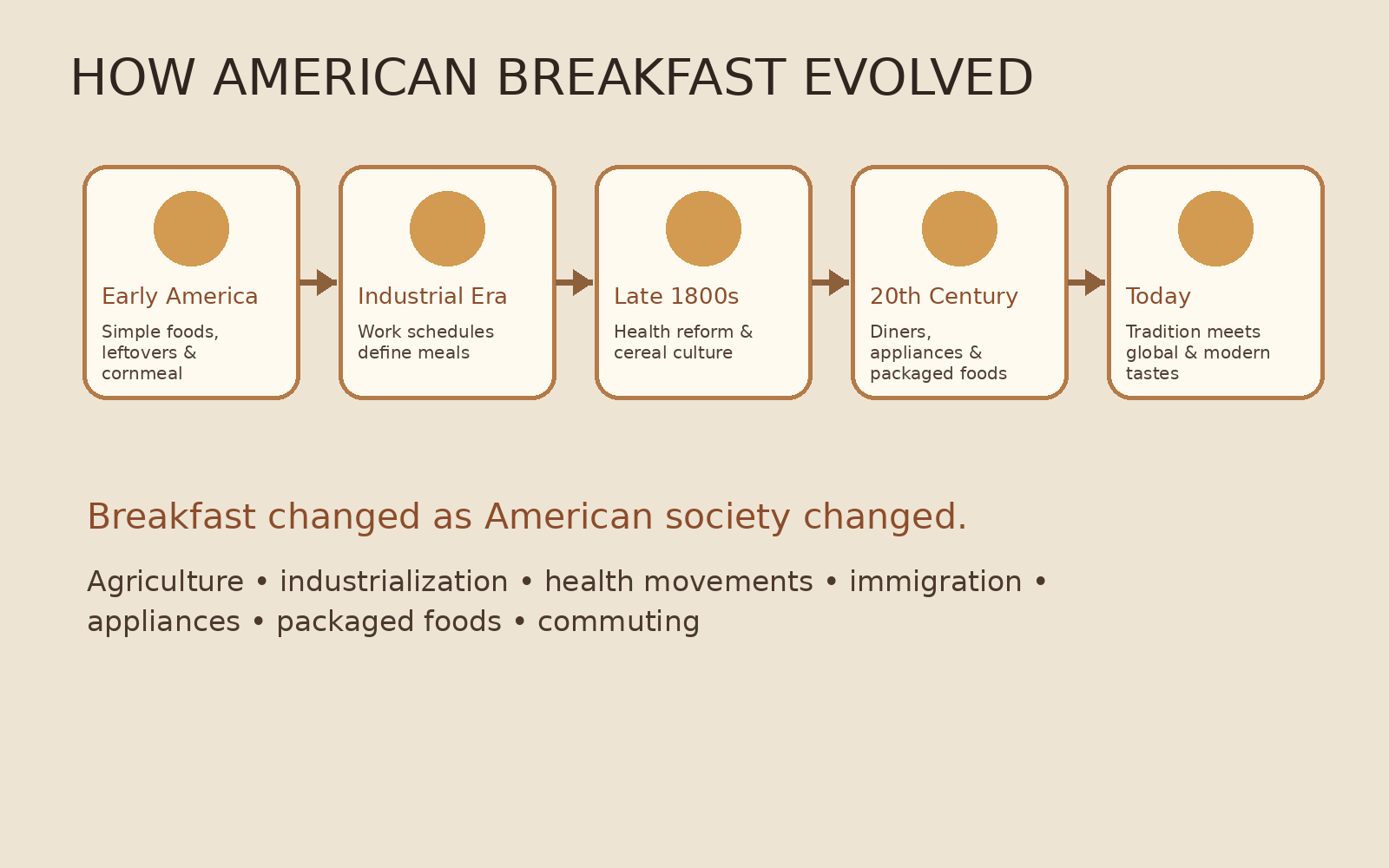
In colonial America, the boundaries between breakfast, lunch, dinner, and supper were not as fixed as they are today. Food historian Abigail Carroll's research, summarized by the Smithsonian, explains that early Americans often ate leftovers, cornmeal mush, and other simple foods in the morning. The hot, substantial meal was more often dinner, while breakfast could function almost like a refueling meal before work.
The Industrial Revolution changed this pattern. As more people moved from agricultural work into factories and cities, work schedules became more structured. The modern three-meal pattern gradually became more recognizable, and specific foods became associated with particular meals.
Breakfast therefore became a cultural category rather than simply “whatever food was available in the morning.”
That distinction helps explain why foods such as cereal, pancakes, eggs, toast, and waffles became strongly identified with American mornings.
Pancakes: The Classic Griddle Breakfast
Few breakfast foods are as recognizable as the American pancake.
Pancakes themselves are ancient and appear in many cultures. Smithsonian food history traces pancake-like foods back thousands of years, while noting that American pancakes developed their own identity. In the United States, the familiar version is generally thicker and fluffier than many international varieties and is often served in stacks with butter and maple syrup.
The basic recipe is wonderfully simple: flour, milk, eggs, a leavening agent, and often a little sugar or butter.
What makes American pancakes special is the combination of texture and toppings. A stack can become a blank canvas for blueberries, strawberries, bananas, chocolate chips, pecans, whipped cream, or other additions.
Pancakes also fit the rhythm of American family breakfasts because the batter can be prepared quickly and cooked in batches on a griddle.
For many people, pancakes are associated with weekends rather than rushed weekday mornings. They represent a slower breakfast, often connected with family, holidays, diners, or childhood memories.
Waffles and the Technology of Breakfast
Waffles share many ingredients with pancakes but have a very different texture because the batter is cooked between patterned plates.
The National Museum of American History notes that waffles arrived in America with Dutch colonists in the 1620s. A major step in their domestic popularity came with Cornelius Swartwout's 1869 patent for an improved stovetop waffle iron. Later, electric waffle irons and packaged mixes made waffle preparation increasingly convenient.
This is a good example of how technology can shape food traditions.
The waffle did not become popular simply because people liked its flavor. Kitchen equipment made it easier to prepare consistently at home.
Modern American waffles are often served with butter and maple syrup, but savory combinations have also become important. Fried chicken and waffles, for example, became a particularly recognizable American pairing.
Waffles can therefore move between sweet breakfast food and a larger comfort-food tradition.
Eggs: The Reliable Breakfast Staple
Eggs are among the most versatile foods in American breakfast culture.
They can be scrambled, fried, poached, boiled, folded into omelets, baked into casseroles, or served alongside meat and toast.
The National Museum of American History notes that European colonists brought chickens to North America, and eggs became an important part of the American diet. By the nineteenth century, chickens were increasingly bred specifically for egg production, making eggs a practical and familiar food.
Eggs became particularly compatible with breakfast because they cook quickly and can be combined with almost anything.
A plate of eggs, bacon, toast, and potatoes is one of the most recognizable American diner breakfasts. But eggs also appear in breakfast sandwiches, breakfast burritos, eggs Benedict, and regional dishes such as eggs with grits.
Their versatility has allowed eggs to survive almost every change in American breakfast culture.
Bacon and Breakfast Sausage
Few aromas announce breakfast more strongly than bacon cooking in a pan.
Bacon became a powerful part of American breakfast culture because it combines salty, smoky, crisp, and savory flavors. It pairs naturally with eggs, pancakes, waffles, toast, potatoes, and breakfast sandwiches.
Breakfast sausage plays a similar role, although regional styles vary. Sausage can be served as links or patties and may be paired with eggs, biscuits, gravy, or potatoes.
The popularity of these foods also reflects a broader history of American meat production and food preservation. Pork was an important farm animal, and preserved pork products could provide concentrated calories and flavor.
Over time, bacon and sausage became less about necessity and more about the recognizable flavor profile of a classic American breakfast.
Hash Browns and Home Fries
Potatoes are another important part of the traditional breakfast plate.
Hash browns are typically shredded potatoes cooked until crisp, while home fries are usually cubed or sliced potatoes cooked in a skillet, often with onions and seasonings.
Both demonstrate an important characteristic of American breakfast: the ability to transform inexpensive staple ingredients into something satisfying.
Potatoes also work well in diners because they can be prepared in large quantities and cooked quickly to order.
A plate containing eggs, meat, and potatoes provides a combination of protein, carbohydrates, salt, and fat that became strongly associated with the classic American diner breakfast.
Biscuits and Gravy: A Southern Breakfast Tradition
In the American South, biscuits and gravy represent a distinctive breakfast tradition.
Soft, flaky biscuits are served with a rich sausage gravy made from milk, flour, and sausage drippings or cooked sausage. The result is hearty, inexpensive, and filling.
Southern breakfast traditions are closely connected with agriculture, local ingredients, African American foodways, European influences, and generations of home cooking.
Biscuits themselves became important because they could be made from relatively basic pantry ingredients. Gravy provided an economical way to add flavor and moisture.
Today, biscuits and gravy are found far beyond the South, but the dish remains strongly associated with Southern comfort food.
It also illustrates an important point about American breakfast: some of the most recognizable dishes developed as practical foods before becoming cultural classics.
Grits: A Southern and Coastal Staple
Grits are made from ground corn and have deep roots in Southern food culture.
Corn itself has Indigenous American origins, and corn-based foods became fundamental to many American regional cuisines. Grits developed particularly strong associations with the Southern states, where they can be served as a breakfast side dish or combined with butter, cheese, seafood, eggs, or meat.
Shrimp and grits demonstrates how a simple grain can become part of a more elaborate regional dish.
Grits also show how American breakfast traditions can overlap with lunch and dinner. A food does not need to remain locked into one meal category.
Oatmeal and the Rise of a “Healthy” Breakfast
Oatmeal has a different image from bacon and pancakes. It is often associated with warmth, nutrition, simplicity, and health.
The history of American breakfast helps explain why this association became so strong. During the late nineteenth and early twentieth centuries, health reformers and entrepreneurs promoted cereal and grain-based foods as healthier alternatives for modern Americans.
Smithsonian's discussion of American meal history describes how health reformers, including Sylvester Graham and figures connected to sanitariums, helped reshape ideas about breakfast. Later, entrepreneurs such as John Harvey Kellogg and Charles Post developed and marketed grain-based breakfast products.
Oatmeal therefore became part of a broader cultural shift.
Breakfast was increasingly presented not just as fuel but as an opportunity to manage health, energy, and daily habits.
Breakfast Cereal and the Modern Pantry
Perhaps no food better represents modern American breakfast than boxed cereal.
Dry cereal became especially successful because it was convenient. There was no need to cook a full meal. A person could pour cereal into a bowl, add milk, and begin eating within minutes.
The rise of cereal also reflected industrial food production, packaging, advertising, refrigeration, supermarkets, and changing household schedules.
Sweet cereals became particularly associated with children, while products marketed around grains, fiber, or nutrition targeted adults.
The cereal bowl is therefore more than a simple breakfast object. It represents the transformation of American eating habits from home-cooked meals toward packaged foods designed for speed and consistency.
Toast, Jam, and the Everyday Breakfast
Toast may be one of the least glamorous breakfast foods, but it is one of the most enduring.
Bread is inexpensive, versatile, and easy to store. Toasting improves texture and creates a warm base for butter, jam, peanut butter, eggs, avocado, or other toppings.
The toaster itself also transformed breakfast. Electric household appliances made it possible to produce evenly toasted bread quickly and repeatedly.
Toast became especially useful as American mornings became more time-conscious.
Unlike a full breakfast plate, toast could be eaten quickly and adapted to different tastes.
Bagels and the Influence of Immigration
Not every food commonly found at an American breakfast originated in traditional Anglo-American cooking.
Bagels became an important part of American breakfast culture through Jewish immigrant communities, particularly in New York.
The classic American bagel breakfast might combine a toasted bagel with cream cheese and smoked salmon, while simpler versions might use butter, jam, or eggs.
This is an excellent example of how American food culture develops: an immigrant food can become part of the national breakfast landscape while retaining connections to the community that introduced and preserved it.
American breakfast is therefore partly a history of immigration.
Breakfast Sandwiches and the Need for Speed
The breakfast sandwich represents another major change in American morning habits.
Eggs, cheese, bacon, sausage, and bread can be combined into a portable meal that does not require a plate or fork.
This format fits commuting, office work, school schedules, and modern fast-food culture.
The breakfast sandwich also demonstrates how older foods can be reorganized into a new form. Eggs, meat, cheese, biscuits, English muffins, and toast were already familiar. Putting them together created a product suited to a faster lifestyle.
The result is one of the clearest examples of American breakfast adapting to modern time constraints.
Diners and the American Breakfast Plate
The American diner helped turn breakfast foods into a recognizable restaurant experience.
A diner menu can bring together pancakes, waffles, eggs, bacon, sausage, potatoes, toast, French toast, coffee, and other dishes on the same page.
This variety is part of the appeal.
A diner breakfast allows customers to customize the meal: eggs cooked a particular way, extra bacon, pancakes instead of toast, home fries instead of hash browns, or a side of grits.
The diner therefore became a place where many separate breakfast traditions could coexist.
Why American Breakfast Feels So Familiar
Traditional American breakfast foods share several characteristics.
They are often affordable, filling, adaptable, and relatively easy to prepare. Many can be cooked in batches, stored conveniently, or modified according to household preferences.
More importantly, breakfast foods carry strong emotional associations.
Pancakes may remind someone of weekend mornings. Bacon may recall a family kitchen. Cereal may bring back memories of childhood television. A diner breakfast may be connected to road trips. Biscuits and gravy may represent a regional home.
Food becomes traditional not only because people have eaten it for a long time, but because people attach memories to it.
American Breakfast Is Still Changing
The traditional breakfast plate continues to evolve.
Modern Americans have added smoothies, yogurt, breakfast burritos, avocado toast, plant-based alternatives, international pastries, and many other foods to the morning menu.
At the same time, classic dishes remain remarkably durable.
Pancakes still appear on weekend tables. Eggs remain a breakfast staple. Waffles continue to inspire both sweet and savory combinations. Cereal remains a convenient pantry food. Regional dishes such as biscuits and gravy continue to represent local traditions.
The American breakfast is therefore both traditional and constantly changing.
Conclusion
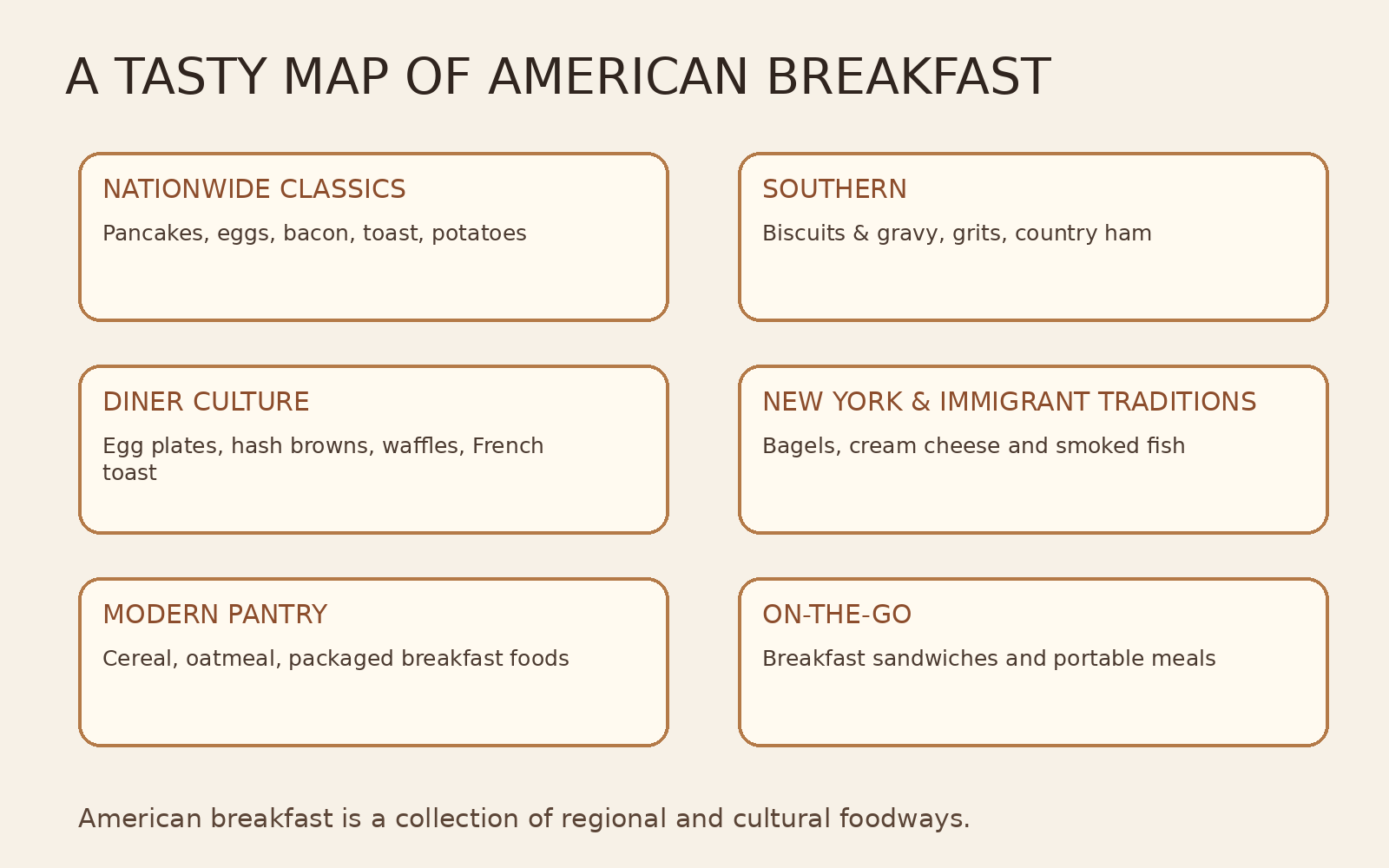
Traditional American breakfast foods are not defined by one recipe. They are defined by a collection of habits, ingredients, technologies, regional traditions, immigrant influences, and memories.
Pancakes and waffles demonstrate the enduring appeal of griddle cooking. Eggs, bacon, sausage, and potatoes form the foundation of the classic diner plate. Biscuits and gravy and grits reflect Southern foodways. Oatmeal and cereal reveal the influence of health movements and industrial food production. Bagels and other immigrant foods show how American breakfast expands through cultural exchange.
Perhaps the most delicious thing about American breakfast is its flexibility.
A traditional breakfast can be a carefully prepared weekend feast or a bowl of cereal eaten in five minutes. It can be sweet or savory, homemade or purchased at a diner, regional or influenced by food traditions from around the world.
That variety is what makes American breakfast more than a meal.
It is a snapshot of American life—busy, diverse, practical, nostalgic, and always evolving.
Sources and Further Reading
Smithsonian Magazine, “A Brief History of Pancakes” (2023).
National Museum of American History, “Pass the Syrup and Enjoy a Slice of History for National Waffle Day” (2017).
Smithsonian Magazine, “A Brief History of the Waffle Iron” (2019).
Smithsonian Magazine, “Why Do We Eat Cereal for Breakfast? And Other Questions About American Meals Answered” (2013).
Smithsonian Institution, “Three Squares: The Invention of the American Meal” by Abigail Carroll.
National Museum of American History, “Chickens, Eggs, and the Changing American Diet” (2015).
Leave a Reply