How the Classic American Burger Became a Global Favorite
Few foods are as closely associated with the United States as the hamburger. A beef patty in a soft bun, often topped with cheese, lettuce, tomato, pickles, onions, ketchup, mustard, or a signature sauce, seems simple. Yet the burger's journey from nineteenth-century ground-meat dishes to a globally recognized meal is a story about migration, industrialization, transportation, advertising, changing lifestyles, and the power of standardization.
The hamburger was not invented in one clearly documented moment. Its origins are debated, and historians have identified several earlier dishes that resemble parts of the modern burger. What is much clearer is that the United States provided the conditions in which the hamburger could become a defining mass-market food.
By the twentieth century, burgers had moved from lunch counters and roadside stands into diners, drive-ins, fast-food restaurants, supermarkets, backyard grills, stadiums, and eventually restaurants around the world. The burger became global not because every country copied the American version exactly, but because the basic format was remarkably adaptable.
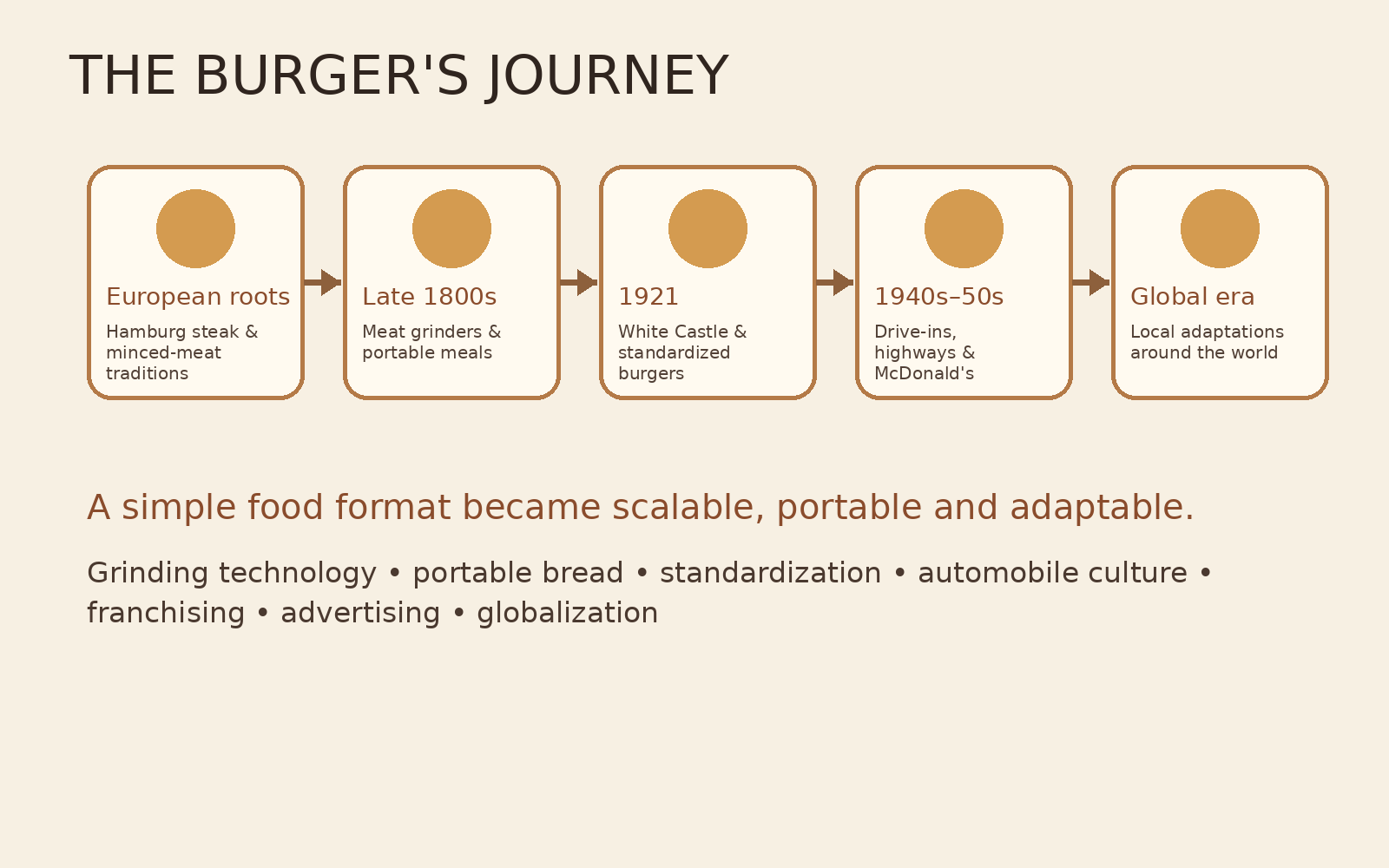
The Hamburger Has European Roots
The word “hamburger” points toward Hamburg, Germany, but the modern hamburger cannot simply be described as a German invention.
Smithsonian's history of the hamburger notes that earlier ground-meat preparations existed in Europe, while Hamburg steak became one of the important predecessors of the American hamburger. A 1763 English cookbook, for example, included a recipe for “Hamburg sausage,” showing that Hamburg-associated minced-meat preparations were known in English-language cooking long before the modern sandwich appeared.
Hamburg steak was different from today's burger. It was essentially a seasoned preparation of ground or minced meat, often served without a bun. German immigrants and transatlantic trade helped bring related food traditions to the United States, where American cooks adapted them to local markets and eating habits.
The crucial transformation was turning ground meat into a portable patty that could be placed inside bread.
Exactly who first did that remains uncertain. Several American towns and individuals have claimed to have invented the hamburger, but historians have not found a single definitive origin story. That uncertainty is actually useful because it shows how foods often emerge from multiple small innovations rather than one dramatic invention.
Grinding Meat Changed What Was Possible
One important development was the spread of mechanical meat grinders.
Smithsonian's examination of hamburger history points to the growing availability of meat-grinding equipment in the late nineteenth century. A popular household grinder could turn tougher or less expensive cuts into ground meat much more efficiently than hand-mincing.
That mattered because the hamburger was perfectly suited to an industrializing food system.
Ground beef could be portioned into uniform patties, cooked quickly, and served with minimal utensils. It could also make economical use of meat that was less desirable as a whole cut.
As grinders became more accessible, the basic burger format became easier for restaurants, vendors, and households to reproduce.
This was an important step toward the standardized hamburger that would later dominate fast food.
Fairs, Lunch Counters, and the Portable Meal
The late nineteenth and early twentieth centuries were full of fairs, festivals, amusement parks, train stations, lunch counters, and other places where people wanted inexpensive food they could eat quickly.
A hamburger was ideal for these environments.
Unlike a steak that required a knife and fork, a ground-beef patty could be cooked quickly and placed between pieces of bread. The customer could eat while standing or walking.
This portability helped the burger become part of America's emerging on-the-go food culture.
The sandwich also fit the needs of workers and travelers. Urbanization was changing daily schedules, while industrial workplaces created large populations that needed inexpensive meals during limited breaks.
The hamburger did not have to be elegant. Its strength was practicality.
White Castle and the Birth of the Modern Burger Chain
One of the biggest turning points came with White Castle.
White Castle opened in Wichita, Kansas, in 1921 and became the first major fast-food chain built around mass-produced hamburgers. Smithsonian describes how the company combined standardized preparation with an almost assembly-line approach to food production.
The burgers were small, inexpensive, and highly standardized.
That consistency helped address an important problem. At a time when consumers were increasingly concerned about meat processing and food safety, a restaurant that looked clean, controlled, and predictable could build trust.
White Castle's founders, Walter Anderson and Billy Ingram, played different but complementary roles in developing the business. Anderson had practical experience with hamburger cooking and restaurant operations, while Ingram focused heavily on business systems, branding, and expansion.
The result was more than a hamburger restaurant. It was an early model for modern fast food.
Standardization Made the Burger Scalable
The hamburger's great advantage for large restaurant companies was that it could be broken down into repeatable steps.
A patty could be a consistent size. Buns could be delivered from suppliers. Toppings could be portioned. Cooking times could be measured. Employees could be trained to follow the same process.
This made the burger compatible with the principles of industrial production.
The National Museum of American History has described food as an important expression of American innovation and technology, and its food exhibitions include objects and experiences related to the development of fast, standardized eating.
The burger therefore became more than a dish. It became a system.
That system could be reproduced in one restaurant, then ten, then hundreds.
The Automobile Changed the Burger Forever
The rise of the automobile created another major advantage.
Americans increasingly traveled by car, and restaurants began adapting to customers who wanted food without sitting down for a long meal.
Drive-ins and roadside restaurants became part of American car culture. Customers could park, order food, and often eat without leaving their vehicles.
Smithsonian's history of McDonald's connects the growth of fast food with the expansion of American driving and the highway system after World War II.
The burger was almost perfectly designed for this environment.
It could be wrapped in paper, carried in one hand, and eaten without a plate. Fries could fit into a small container, while a drink completed the meal.
The hamburger became synchronized with a faster, more mobile lifestyle.
McDonald's Turned the Burger Into a Global Business Model
McDonald's did not invent the hamburger or even the fast-food chain. White Castle had already demonstrated the potential of standardized burgers, while many drive-ins and roadside restaurants were operating across the United States.
What McDonald's did was develop an exceptionally scalable franchise and operations system.
The McDonald brothers opened their drive-in restaurant in San Bernardino, California, in 1940. They later simplified the operation by reducing table service, cutting the menu, and emphasizing speed and consistency. Ray Kroc became involved in the 1950s and helped build a nationwide franchise system.
Standardization was central to the model.
A customer could travel hundreds or thousands of miles and encounter a familiar type of restaurant, familiar packaging, familiar menu structure, and a familiar burger.
That predictability became one of the most powerful features of the fast-food model.
Advertising Turned the Burger Into an American Symbol
The burger's cultural power did not come from food alone.
Advertising transformed the hamburger into a symbol of American everyday life.
Fast-food companies promoted burgers through television, billboards, newspapers, roadside signs, children's marketing, celebrity endorsements, memorable characters, and slogans.
The burger became associated with road trips, family outings, sports events, suburban life, lunch breaks, and casual gatherings.
This was important because food brands were no longer simply selling ingredients. They were selling experiences and memories.
A burger could represent freedom on the highway, convenience after work, a meal with friends, or a childhood family trip.
Ketchup, Cheese, Pickles, and the Language of Customization
Another reason burgers traveled so well is that the basic format can absorb almost anything.
The classic American burger is already a modular food. The patty is the center, while the bun and toppings can change.
Ketchup became particularly important. Smithsonian notes that ketchup became deeply associated with American foods such as hamburgers and fries and eventually became recognizable around the world as an emblematic U.S. condiment.
Cheese transformed the burger into the cheeseburger. Pickles added acidity. Onions added sweetness and sharpness. Mustard brought heat and tang.
Once the structure existed, regional and cultural adaptations were easy.
The burger could remain recognizable while changing its flavor profile.
From American Classic to Global Food
The burger's international expansion accelerated during the second half of the twentieth century.
American fast-food chains opened restaurants in cities across Europe, Asia, Latin America, the Middle East, Africa, and Oceania. Local cooks and restaurant companies also adopted the burger format and modified it according to local tastes.
This is where the burger became genuinely global.
A hamburger in another country does not have to be identical to an American hamburger. Local ingredients, sauces, spices, cheeses, breads, and cooking methods can create something quite different while preserving the basic idea of a patty served in a bun.
That flexibility is one of the burger's greatest strengths.
The Burger Adapted to Local Cultures
Globalization did not simply make American burgers identical everywhere.
Instead, the burger became a canvas for local food cultures.
Restaurants can use regional meats, local vegetables, distinctive sauces, spicy seasonings, specialty cheeses, or alternative breads. Some versions use chicken, fish, vegetables, beans, or plant-based patties rather than beef.
This process is similar to what happened with other globally popular foods: a basic format travels, but the destination changes it.
The result is a family of burgers rather than one universal burger.
The American hamburger remains the reference point, but local interpretations can become independent culinary traditions.
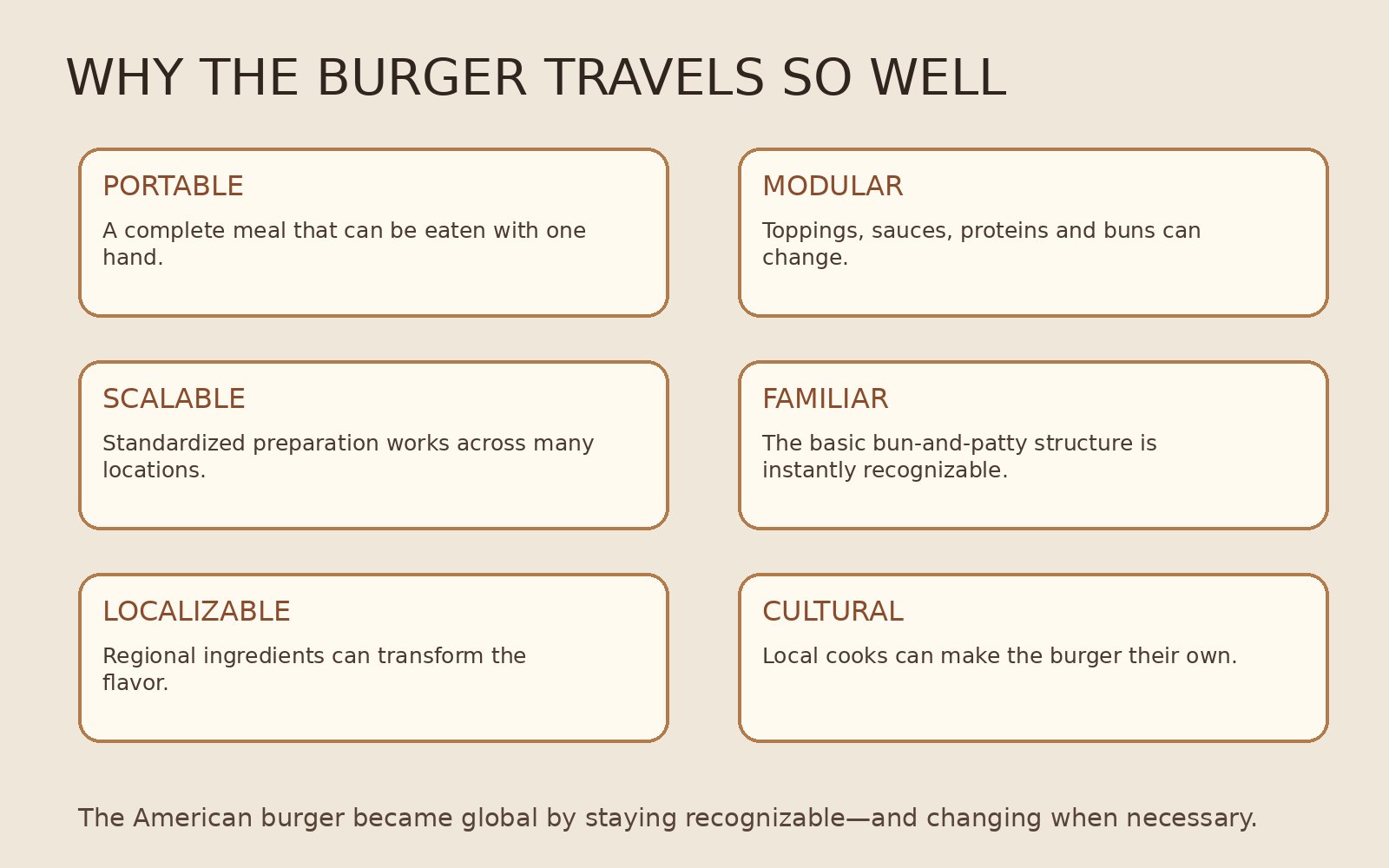
Why the Burger Is So Easy to Globalize
There are several practical reasons for the burger's international success.
First, the format is simple. A protein or plant-based patty plus bread creates a complete handheld meal.
Second, the ingredients can be substituted easily. Beef can be replaced with chicken, fish, vegetables, beans, or other proteins.
Third, the toppings are flexible. Sweet, spicy, sour, salty, smoky, or creamy flavors can all work.
Fourth, the cooking process is relatively straightforward. Grilling, frying, or griddling can produce a burger without complicated equipment.
Finally, the burger is visually recognizable. A bun surrounding a patty immediately communicates what kind of food the customer is about to eat.
That combination of simplicity and adaptability is unusually powerful.
Gourmet Burgers and the Reinvention of the Classic
The burger's global popularity did not prevent it from becoming a premium restaurant food.
In the late twentieth and early twenty-first centuries, chefs increasingly experimented with burgers made from higher-quality beef, specialty buns, aged cheeses, unusual sauces, and elaborate toppings.
This created a fascinating contrast.
The same basic dish could be sold as an inexpensive fast-food meal and as a premium restaurant creation.
The burger therefore became a culinary bridge between everyday eating and food culture.
It could be standardized or handcrafted, cheap or expensive, simple or elaborate.
The Burger as a Cultural Object
The hamburger's story reveals something important about American culture.
It represents mobility, industrial production, entrepreneurship, convenience, advertising, and mass consumption. At the same time, it also represents backyard grilling, diners, family meals, local restaurants, and regional pride.
Smithsonian's history of the hamburger describes it as deeply connected to twentieth-century American identity, particularly through the rise of chains, franchises, standardized production, and branding.
That does not mean every American experiences the burger in the same way. Food preferences vary widely.
But few dishes have been so closely tied to the story of modern American commerce and everyday life.
The Burger's Global Future
The hamburger continues to change.
Plant-based alternatives have created new versions of the classic format. Restaurants experiment with international sauces and spices. Local burger shops compete with major chains by emphasizing regional ingredients and handmade preparation.
At the same time, the traditional burger remains remarkably durable.
Its future is likely to involve both preservation and experimentation. The familiar bun-and-patty structure will continue to provide a foundation for new combinations.
The burger's history suggests that this adaptability is not a recent development. It has been part of the food's identity from the beginning.
Conclusion
The classic American burger became a global favorite through a combination of historical circumstances and culinary flexibility.
Its roots stretch into European ground-meat traditions, but the modern hamburger took shape in the United States. Mechanical meat grinders made patties easier to produce. Portable bread made them easier to eat. Lunch counters, fairs, and roadside stands created new markets. White Castle demonstrated that burgers could be standardized. Automobile culture helped drive the growth of fast food. McDonald's transformed standardized burgers into a global franchise model.
But technology and business alone do not explain the burger's staying power.
People like the format because it is practical, customizable, familiar, and easy to share. Every culture that adopts it can change it.
That may be the most important reason the American burger became a global favorite: it is recognizable enough to travel, but flexible enough to become local.
From a roadside diner in the United States to a modern restaurant on the other side of the world, the burger continues to prove that a simple idea can have an extraordinarily long journey.