The Story Behind America’s Favorite Comfort Foods

Introduction
Comfort food is rarely just about taste. A familiar dish can carry memories of family dinners, holidays, school cafeterias, neighborhood restaurants, celebrations, hard times, and the people who taught us how to cook. In the United States, foods such as apple pie, fried chicken, macaroni and cheese, barbecue, hamburgers, and Thanksgiving dishes have become powerful examples of that connection between food and memory.
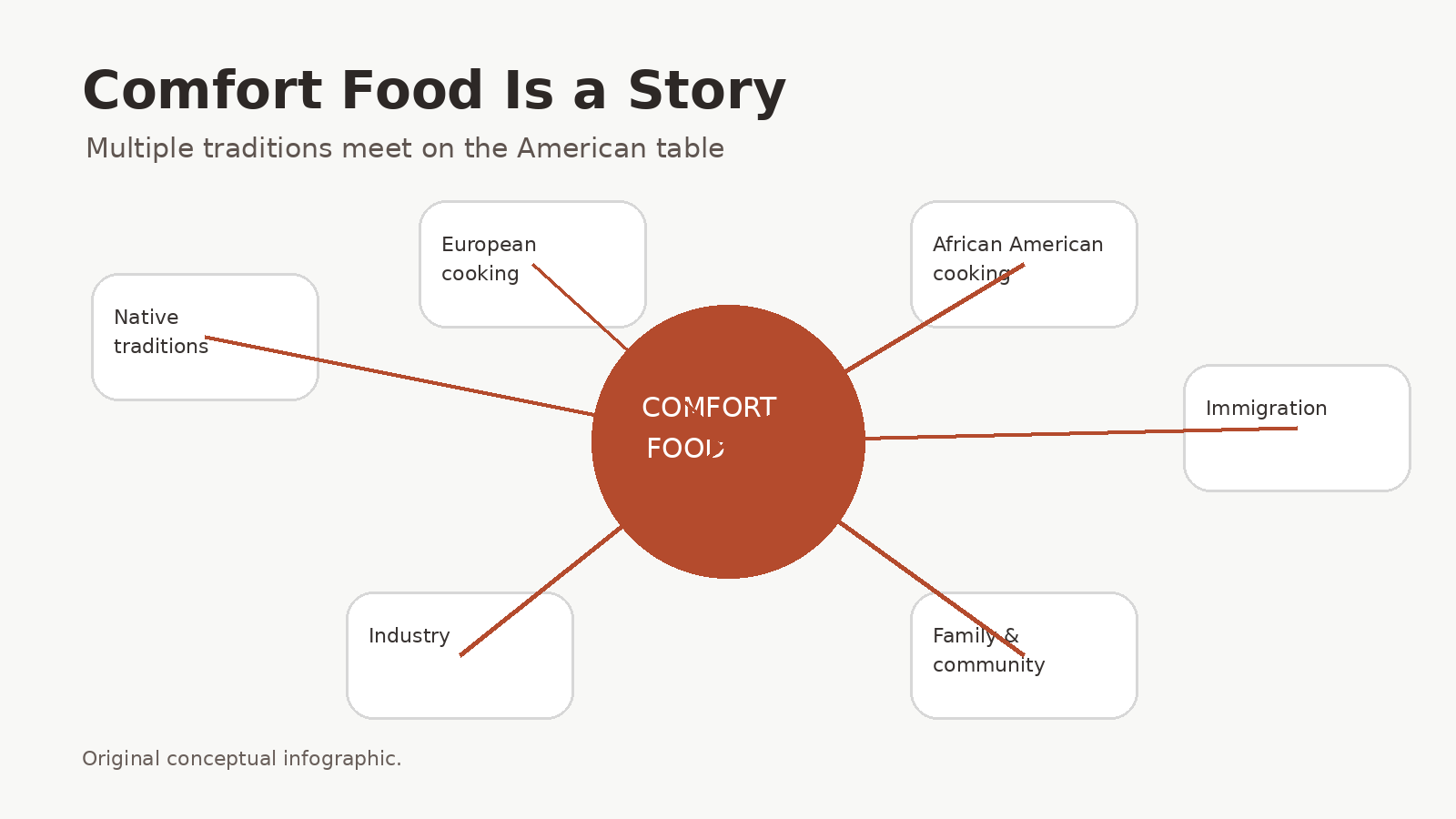
Yet the phrase “American comfort food” can be misleading if it suggests that these dishes came from one single tradition. American food developed through Native traditions, Indigenous ingredients, European colonization, African culinary knowledge, immigration, industrialization, regional agriculture, changing transportation, and modern food businesses. What Americans now describe as classic comfort foods often have complicated histories.
That complexity is part of what makes these foods so interesting. A dish can become deeply associated with American identity while still reflecting influences from somewhere else. It can begin as practical household food and later become a restaurant staple. It can move from a regional specialty to a national favorite through railroads, highways, canned foods, supermarkets, advertising, and television.
The story of American comfort food is therefore also a story about how the country changed.
What Makes a Food “Comfort Food”?
There is no single official definition of comfort food. The term generally describes foods people associate with emotional familiarity, pleasure, security, or nostalgia. The important ingredient is often not a particular recipe but a relationship with the food.
That relationship explains why two people can have completely different ideas about comfort food. One person may think of chicken soup, another of macaroni and cheese, another of biscuits and gravy, and another of a regional dish learned from grandparents. Comfort food is personal, even when millions of people share the same dish.
American comfort foods also tend to be practical. Many developed around inexpensive or widely available ingredients: flour, potatoes, corn, dairy products, meat, beans, fruit, and grains. Other foods became popular because industrial processing made them cheaper, easier to store, transport, or prepare.
This combination of familiarity and practicality helped certain foods survive across generations. Recipes changed, but the emotional association remained.
Apple Pie and the Idea of American Nostalgia
Few foods are more closely linked with American identity than apple pie. The famous expression “as American as apple pie” makes the dessert sound uniquely American, but its history is more complicated.
The pie tradition arrived with European settlers, particularly from British culinary traditions. In the American colonies, cooks adapted pie-making to local conditions and ingredients. Apples grew well in many parts of the country and could be stored for long periods, making them particularly useful. Over time, sweet fruit pies became an important part of American cooking.
Smithsonian Magazine notes that apple pie became especially prominent by the late nineteenth and early twentieth centuries. It was not simply a dessert: pie became connected to ideas about home, prosperity, family, and eventually national identity. During World War I, American newspapers even connected the desire for pie abroad with patriotic ideas. By the twentieth century, “American as apple pie” had become a familiar cultural phrase.
That history explains why apple pie feels larger than the recipe itself. Its cultural meaning developed gradually. A dessert made with fruit and pastry became a symbol of home and nostalgia.
Macaroni and Cheese: From Imported Pasta to American Classic
Macaroni and cheese demonstrates how a food can cross borders before becoming an everyday American favorite. The combination of pasta and cheese has European roots, while the dish became established in American cooking through several historical pathways.
Thomas Jefferson is often associated with macaroni and cheese because of his interest in pasta after traveling in Europe. Smithsonian historical coverage notes that Jefferson brought back pasta-related knowledge and a pasta machine, and that macaroni and cheese was served at an 1802 state dinner during his presidency.
But the story does not end with Jefferson. Food history also highlights the role of James Hemings, an enslaved chef associated with Jefferson, who learned European cooking techniques. Macaroni and cheese later developed through African American food traditions as well as broader American home cooking.
The twentieth century transformed the dish again. Processed cheese and boxed mixes made macaroni and cheese inexpensive, shelf-stable, and quick to prepare. Smithsonian Magazine describes this combination of industrial food production, convenience, and affordability as a major reason the dish became such a recognizable American comfort food.
That history gives macaroni and cheese several identities at once: a homemade side dish, a celebration food, an inexpensive family meal, and a symbol of childhood.
Fried Chicken and the Deep Roots of Southern Cooking
Fried chicken is another food whose American history cannot be separated from African American culinary traditions and the history of the American South.
A printed American recipe for fried chicken appeared in Mary Randolph’s 1824 cookbook The Virginia House-Wife. Smithsonian reporting notes that Randolph’s recipe is widely considered the first published American fried-chicken recipe, but also emphasizes that Southern fried chicken had deeper roots and was shaped by enslaved cooks and a mixture of culinary techniques.
African American women also played an important role in turning fried chicken into a commercial food. During the nineteenth century, Black women in places such as Gordonsville, Virginia, sold fried chicken, biscuits, and pies to passengers through train windows. The railroad created a market for food that could be prepared in advance, carried easily, and eaten during travel.
Fried chicken later moved far beyond the South. Restaurants, fast-food chains, migration, television, and changing eating habits helped make it a national favorite.
Its comfort-food status comes partly from texture and flavor, but its cultural importance is deeper. Fried chicken connects home cooking, entrepreneurship, regional identity, African American culinary history, and modern American restaurant culture.
Barbecue: Regional Identity on a Plate
Barbecue may be one of the clearest examples of how American comfort food can represent regional identity. The word and cooking tradition have roots connected to the Caribbean, while American barbecue developed in different ways across the South and beyond.
Smithsonian Magazine describes barbecue as a tradition of cooking meat slowly over indirect heat and traces its evolution into several distinct regional styles.
The regional differences can be striking. In one area, pork may be central; elsewhere, beef takes the spotlight. Sauces can be sweet, tangy, spicy, thin, or thick. Smoking woods, cooking times, cuts of meat, and serving traditions vary.
That variety is exactly why barbecue works so well as comfort food. It represents place. A barbecue meal can remind someone of a hometown, family gathering, summer holiday, roadside restaurant, or neighborhood tradition.
Modern barbecue also demonstrates how comfort food continues to evolve. Restaurants combine traditional methods with new ingredients, and regional styles travel across the country. Yet the basic idea remains familiar: slow cooking, smoke, shared food, and time spent together.
Hamburgers and the Rise of Everyday American Food
The hamburger is often presented as an obvious symbol of American food, but its development also reflects migration and industrial change.
Hamburger-style foods have connections to European traditions of minced meat, while the American hamburger emerged as a convenient way to serve ground beef in a portable form. Its popularity grew alongside diners, lunch counters, roadside restaurants, drive-ins, and eventually fast-food chains.
The National Museum of American History holds a 1944 photograph showing multiple ways of preparing hamburgers, demonstrating how established the food had become by the mid-twentieth century.
The hamburger became especially compatible with twentieth-century American mobility. As car ownership increased and highways expanded, restaurants adapted to customers who wanted meals that were affordable, portable, and quick. Smithsonian’s history of American fast food connects the expansion of fast food with the growth of highway travel and an increasingly mobile lifestyle.
Today the hamburger can represent many different things: a backyard cookout, a diner lunch, a fast-food meal, a gourmet restaurant creation, or a homemade dinner. Its adaptability is one reason it became such a durable comfort food.
Thanksgiving: When Food Becomes Tradition
Some American comfort foods are inseparable from holidays. Thanksgiving is perhaps the strongest example because its food traditions turn a meal into a national ritual.
The modern Thanksgiving table often includes turkey, stuffing or dressing, potatoes, cranberry sauce, vegetables, rolls, and pie. But the holiday’s history is more complicated than the familiar modern picture suggests.
The Library of Congress explains that Thanksgiving has roots in multiple celebrations and traditions across North America, including long-standing Native practices of giving thanks. The national holiday developed over centuries and became firmly established during the nineteenth century.
Food played a major role in shaping the holiday. Nineteenth-century writers and recipe publishers promoted dishes such as turkey, oysters, potatoes, cranberries, and pie. Sarah Josepha Hale, a magazine editor and advocate for a national Thanksgiving, promoted recipes and traditions that helped standardize the holiday’s cultural image.
Thanksgiving shows how comfort food can become collective memory. A recipe may be ordinary on a normal day, but when served every year at the same holiday, it becomes part of a family and national ritual.
Soul Food and the Power of Community
American comfort food cannot be fully understood without African American culinary history. Foods associated with soul food—such as fried chicken, macaroni and cheese, greens, beans, sweet potato pie, and cornbread—reflect generations of adaptation, creativity, survival, celebration, and community.
Smithsonian coverage of soul food highlights how these dishes are connected with family gatherings, church events, reunions, and other communal occasions.
Soul food also demonstrates why it is risky to describe American food as a simple list of “national dishes.” A recipe can have different meanings depending on who prepares it and where it is served.
For many families, comfort food is a form of inheritance. The recipe may never have been written down. It may be remembered through measurements like “a little salt” or “until it looks right.” The knowledge travels through observation and repetition.
That kind of cooking carries history in a particularly intimate form. A plate of food can preserve stories that might otherwise disappear.
Immigration Changed the Meaning of American Comfort Food
America’s comfort-food tradition has never been static. Immigration continually introduced new ingredients, techniques, and dishes, while existing traditions adapted to them.
This is one reason the category of American food is so broad. Italian-American pasta dishes, Jewish-American deli foods, Chinese-American takeout, Mexican-American regional cooking, Cajun and Creole food, and many other traditions have become part of the everyday American food landscape.
The same process can happen within a single dish. Ingredients may change because they are cheaper or easier to find in a new location. Cooking methods may adapt to available equipment. Restaurants may modify recipes for local customers. Eventually, the modified version can become a new tradition in its own right.
Comfort food therefore does not require ancient origins. A dish can become meaningful surprisingly quickly when it becomes connected to family routines, celebrations, migration, or a particular community.
Convenience Helped Create Modern Comfort Food
Industrialization changed American cooking as dramatically as any recipe. Refrigeration, canned foods, processed cheese, frozen meals, supermarkets, home appliances, and packaged mixes all changed what people could cook and how much time they needed to spend doing it.
Macaroni and cheese provides a clear example. Boxed versions made the dish dramatically easier to prepare, helping transform it from a recipe into a pantry staple.
The same broader pattern affected countless foods. Convenience did not necessarily replace homemade cooking; instead, it created another version of it. A family might make a dish entirely from scratch for a holiday and use a packaged version on a busy weekday.
This flexibility is an important part of modern comfort food. People do not always seek authenticity in the strict historical sense. Sometimes the food that provides comfort is precisely the version that appeared in childhood—a boxed meal, frozen pie, fast-food burger, or restaurant dish.
Why These Foods Still Matter Today
American comfort foods continue to evolve because the society around them continues to change. New immigrant communities, dietary preferences, restaurant trends, technology, and social media all influence what people cook and share.
At the same time, nostalgia remains powerful. A familiar smell can bring back a childhood kitchen. A holiday dish can connect several generations. A regional specialty can remind someone of home after moving across the country.
The Smithsonian’s broader coverage of American food emphasizes that cuisine is closely linked with culture, celebration, history, and technological change.
That is perhaps the most useful way to understand comfort food. It is not simply a collection of heavy or familiar dishes. It is food with a story attached.
Sometimes that story is about immigration. Sometimes it is about hardship. Sometimes it is about entrepreneurship, regional pride, family, religion, holidays, or convenience. Often, several of these stories overlap.
Conclusion
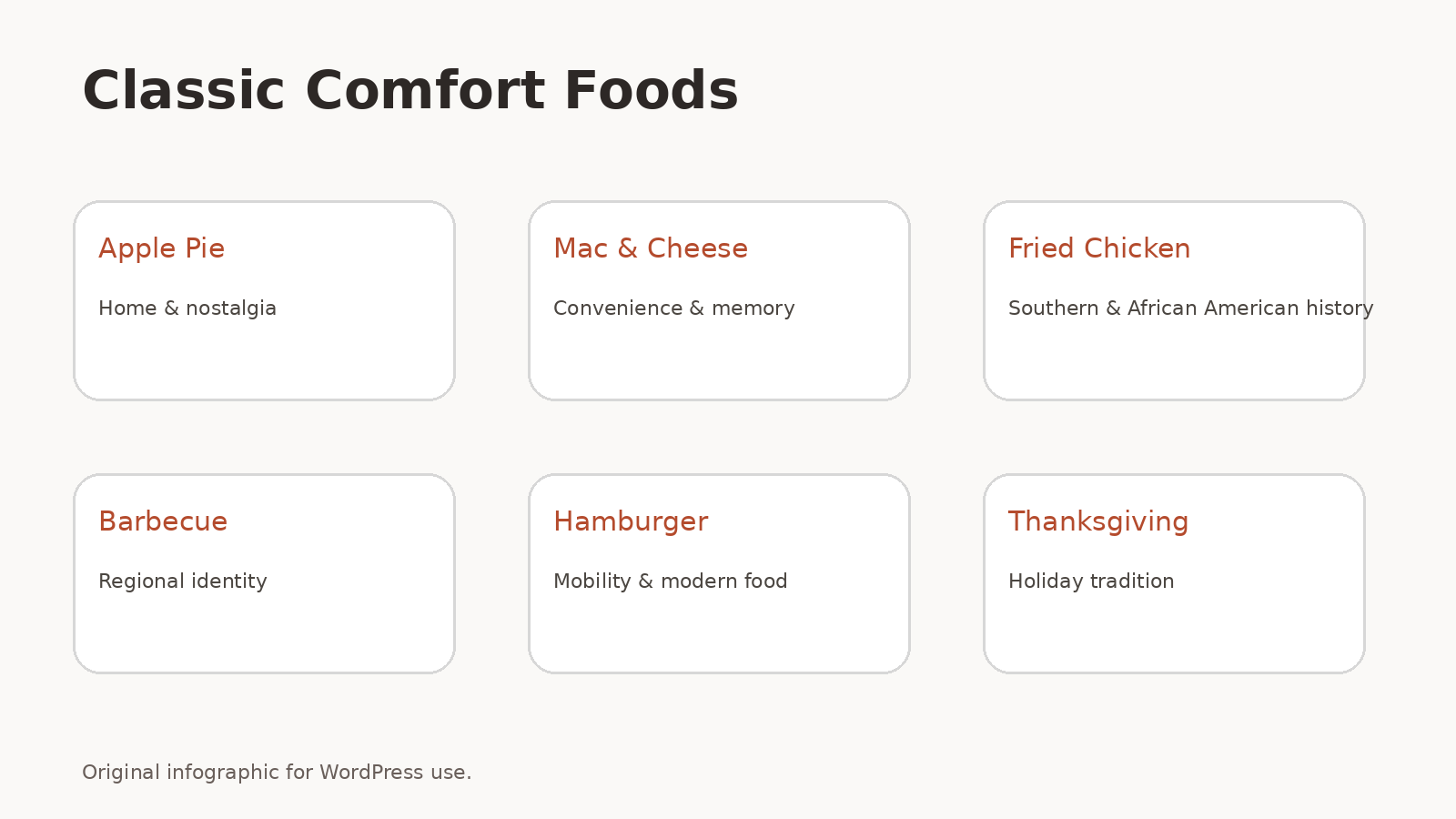
The story behind America’s favorite comfort foods is ultimately a story about people. Apple pie became a symbol of home and national identity. Macaroni and cheese traveled from European culinary traditions into American political, industrial, African American, and family cooking histories. Fried chicken reflects Southern traditions and the contributions of Black cooks and entrepreneurs. Barbecue carries regional identity. Hamburgers grew alongside American mobility and modern restaurant culture. Thanksgiving foods turned meals into annual rituals.
None of these foods has a single, simple origin story. Their meanings were built over generations.
That is what makes American comfort food so compelling. The dishes may look ordinary, but they contain traces of migration, agriculture, technology, economics, race, region, family, and memory.
The next time someone sits down to a plate of mac and cheese, a slice of apple pie, fried chicken, barbecue, or a hamburger, the meal can be understood as more than food. It is a small piece of American history—adapted, shared, remembered, and continually reinvented.
Leave a Reply