Why Mac and Cheese Became an American Food Icon
Few dishes are as simple, recognizable, and emotionally powerful as macaroni and cheese. At its most basic, the formula is almost impossible to misunderstand: cooked pasta, a rich cheese sauce, and enough heat to turn the combination into a warm, satisfying meal. Yet the story of mac and cheese is much larger than the bowl in front of us.
Macaroni and cheese became an American food icon because it connects several important chapters of American food history: European culinary traditions, the kitchens of the early United States, the labor and knowledge of enslaved cooks, industrial food production, wartime rationing, convenience culture, family meals, and the modern idea of comfort food.
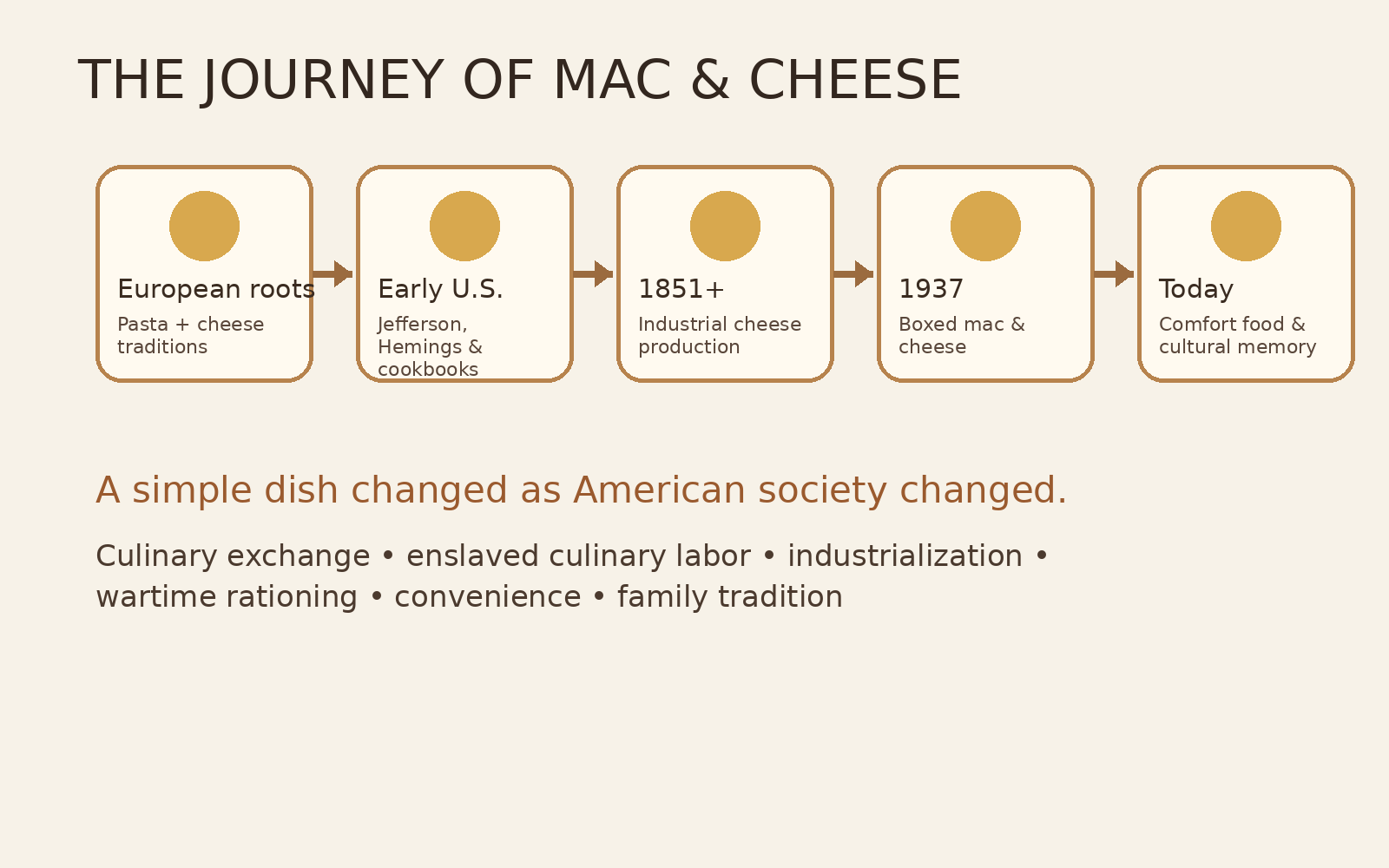
The dish did not begin as an exclusively American invention. Written recipes combining pasta and cheese existed in Europe long before the United States was founded. Smithsonian historians note that the earliest known recorded mac-and-cheese recipe dates to 1769, while other food historians trace pasta-and-cheese combinations even further back. What changed in America was not simply the recipe, but the role the dish came to play in everyday life.
From an elegant dish served in elite households to an inexpensive boxed dinner found in millions of American pantries, mac and cheese traveled through social classes and generations. Its history helps explain why a food can become culturally important without being complicated.
European Roots, American Identity
Macaroni and cheese has European roots, particularly in traditions that combined pasta with cheese. During the eighteenth century, pasta was increasingly associated with European travel, fashion, and elite dining. Thomas Jefferson is frequently connected with the dish because of his interest in European foods and his exposure to pasta while traveling.
Jefferson's connection, however, should not obscure the role of James Hemings, the enslaved chef who worked in Jefferson's household. Hemings traveled with Jefferson to France and received culinary training there. Smithsonian accounts emphasize that Hemings was an important figure in bringing French culinary techniques into the Monticello kitchen.
Jefferson later served macaroni at a state dinner in 1802, helping cement the association between the dish and early American elite culture. But the story did not stop in presidential dining rooms. Over time, recipes for macaroni and cheese entered American cookbooks and domestic kitchens.
Mary Randolph's 1824 cookbook, The Virginia House-Wife, is often recognized as the first American cookbook to publish a macaroni-and-cheese recipe. That development is important because cookbooks helped move recipes from individual households into a wider American food culture.
James Hemings and the Overlooked Labor Behind the Dish
The history of mac and cheese also shows why food history should look beyond famous names.
Thomas Jefferson is often credited with popularizing macaroni and cheese in the United States, but the culinary work involved enslaved cooks who prepared food, adapted recipes, and maintained sophisticated kitchen traditions. James Hemings is especially significant because he received formal French culinary training and worked in Jefferson's kitchen.
This does not mean that one person invented the dish. The broader history is more complicated. Pasta and cheese combinations already existed in Europe, while American cooks transformed them according to local ingredients, household practices, and cultural traditions.
Recognizing Hemings changes the story from a simple tale about a famous statesman discovering a fashionable dish. It becomes a story about knowledge, labor, cultural exchange, and the people who actually cooked the food.
From Special Dish to Household Staple
During the nineteenth century, macaroni and cheese gradually became more familiar in American kitchens. Cheese production itself was changing as the country industrialized. Smithsonian reporting notes that the first U.S. cheese factory was established in 1851, marking an important stage in the industrialization of cheese production.
Industrial food systems made ingredients more standardized and increasingly available beyond the farm. This mattered for a dish built around two basic ingredients: pasta and cheese.
Mac and cheese also had an advantage that many elaborate dishes lacked: it was adaptable. A household could use a sharp aged cheese, a mild cheese, leftovers, breadcrumbs, butter, milk, or whatever ingredients were available. The recipe could be rich enough for a celebration or simple enough for an ordinary family meal.
That flexibility helped the dish cross economic and regional boundaries.
The Great Depression and the Rise of Boxed Mac and Cheese
The biggest transformation came in the twentieth century.
In 1937, Kraft introduced its boxed macaroni and cheese in the United States. Smithsonian sources report that the product cost 19 cents and was marketed as a four-serving meal that could be prepared quickly.
The timing was crucial. America was still living with the economic consequences of the Great Depression, and inexpensive, filling foods were extremely valuable. Boxed mac and cheese offered pasta and cheese flavor in a form that was cheap, shelf-stable, portable, and easy to prepare.
The product became even more important during World War II. Rationing affected supplies of meat and other foods, while shelf-stable pantry products offered practical alternatives. According to Smithsonian reporting, consumers could use two boxes of Kraft macaroni and cheese for only two ration points, helping make it an attractive meal during wartime.
This is one of the key reasons mac and cheese became an American icon. The boxed version was not simply a new recipe. It fit the structure of modern American life.
Convenience Changed the Meaning of Comfort Food
Processed cheese played an important role in this transformation.
Before widespread household refrigeration, keeping cheese fresh could be difficult. Processed cheese technology helped extend shelf life and made cheese products easier to store and transport. Kraft eventually developed a powdered cheese sauce that could be packaged alongside dried pasta.
The result was a meal that could sit in a cupboard for months and become dinner within minutes.
This convenience changed the emotional relationship Americans had with mac and cheese. Children could learn to prepare it. Parents could make it after a long day. College students could cook it with minimal equipment. Families could keep a box in the pantry for emergencies or busy nights.
The food became associated not only with flavor, but with reliability.
That is one of the defining characteristics of comfort food: it often represents predictability. When everything else feels complicated, a familiar bowl can be reassuring.
Mac and Cheese as Celebration Food
It would be a mistake to think of mac and cheese only as cheap or convenient food.
For many African American families, particularly in Southern food traditions, macaroni and cheese has also been associated with gatherings, celebrations, holidays, and special meals. Smithsonian food-history reporting notes that in the antebellum South, mac and cheese could function as a weekend and celebration dish, and that the tradition continued within African American communities.
This gives the dish another layer of meaning. The same basic food can be a quick weeknight dinner for one family and a carefully prepared holiday side dish for another.
That ability to carry different meanings is part of mac and cheese's cultural power.
A homemade version might include multiple cheeses, evaporated milk, eggs, spices, or a crisp baked topping. Another household might prefer a creamy stovetop preparation. Someone else might remember the familiar orange sauce from a childhood boxed meal.
There is no single American mac and cheese.
The Box Became a Cultural Memory
The bright boxed version deserves special attention because it helped create a shared food memory.
For generations of Americans, opening a box, boiling pasta, draining it, adding butter and milk, and stirring in the cheese powder became a small household ritual. It was inexpensive and predictable, but it also became nostalgic.
Food nostalgia is powerful because taste and smell can connect directly to memory. A bowl of mac and cheese can remind someone of childhood, school lunches, college apartments, family dinners, babysitters, holidays, or the first meal they learned to make themselves.
That emotional association helps explain why adults continue to eat a food they may have first encountered as children.
From Pantry Staple to Restaurant Trend
American food culture eventually transformed mac and cheese again.
As chefs became increasingly interested in comfort food, the dish began appearing in restaurants in more elaborate forms. Chefs experimented with aged cheddar, Gruyère, blue cheese, smoked cheeses, vegetables, herbs, meats, breadcrumbs, and specialty pasta.
This created an interesting cultural loop. Mac and cheese moved from European-inspired elite cuisine into American home kitchens, became an inexpensive industrial pantry food, and then returned to restaurants as a dish that could be reimagined with premium ingredients.
The basic formula remained recognizable even when the price and presentation changed.
That adaptability is a major reason the dish has survived so many changes in American eating habits.
Why Mac and Cheese Feels So American
Calling mac and cheese an American icon does not mean the dish was invented in the United States. Its ingredients and earliest traditions have international roots.
What makes it distinctly American is the way the dish was transformed.
It reflects immigration and cultural exchange. It reflects the history of enslaved culinary labor. It reflects industrialization and mass production. It reflects the economic pressures of the Great Depression and wartime rationing. It reflects the growth of supermarkets, packaged foods, and convenience cooking. And it reflects the modern American attachment to foods that connect everyday life with memory.
In that sense, mac and cheese is almost a miniature history of American food culture.
It can be sophisticated or inexpensive. Homemade or industrial. A side dish or a main course. A holiday favorite or a five-minute dinner. A childhood memory or a restaurant specialty.
Few dishes can occupy all of those roles at once.
The Future of an American Classic
Mac and cheese continues to evolve.
Modern cooks have adapted it for vegetarian, gluten-free, and plant-based diets. Restaurants continue to create new versions. Home cooks experiment with regional cheeses and international flavors. At the same time, many people still return to the simplest versions because familiarity is part of the appeal.
The future of mac and cheese is therefore unlikely to be about replacing the classic. Instead, it is about expanding what the classic can mean.
The dish has already survived centuries of culinary change. It moved from European kitchens to the early United States, through elite households and enslaved kitchens, into cookbooks, factories, supermarkets, wartime pantries, family kitchens, college dorms, and restaurants.
Its ingredients remain simple.
Its history is not.
Conclusion
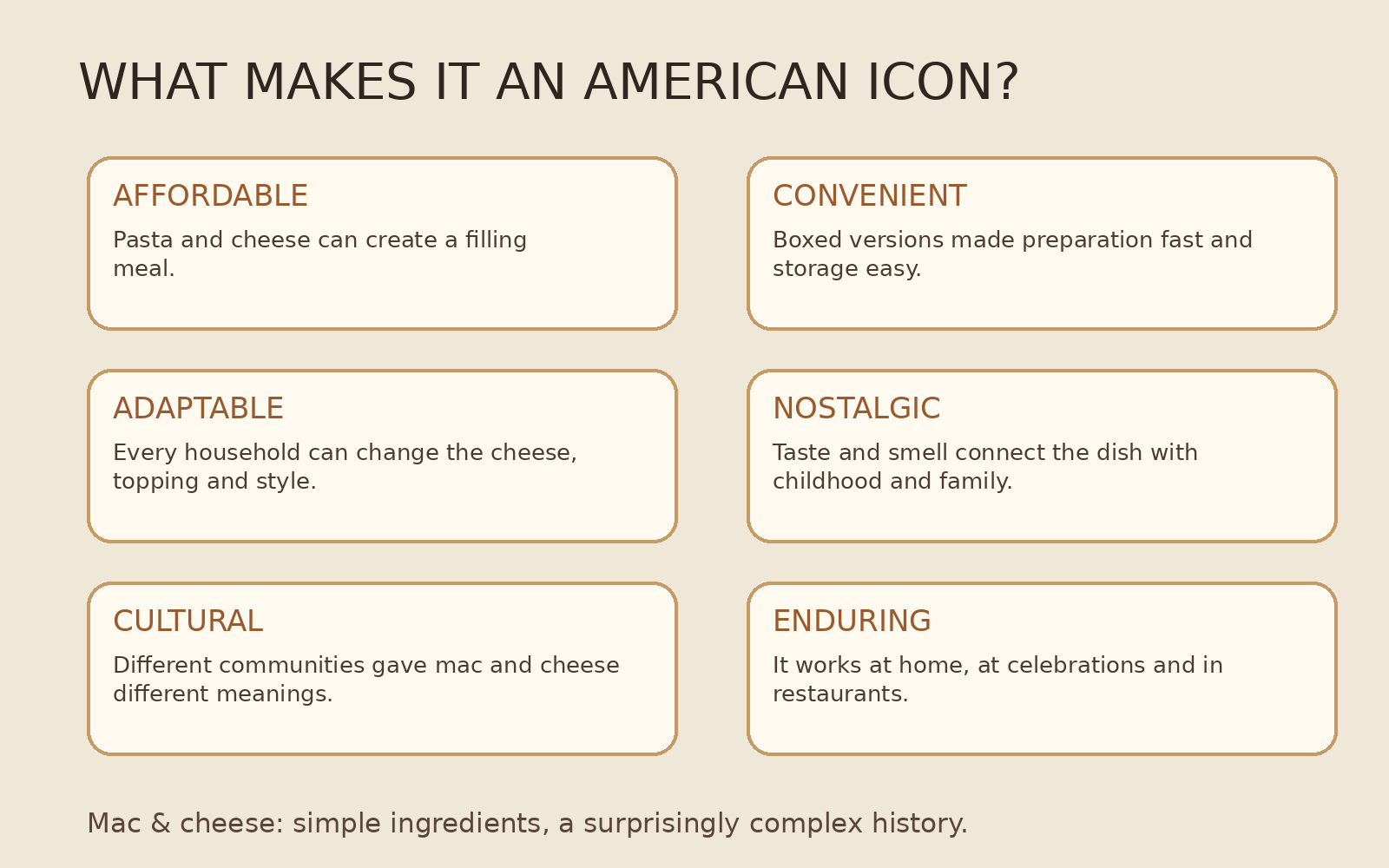
Macaroni and cheese became an American food icon because it was perfectly suited to American life. It was adaptable enough to absorb different culinary traditions, affordable enough to become an everyday meal, convenient enough to fit industrial food culture, and familiar enough to become a powerful symbol of comfort.
Its story also reminds us that food history is rarely about a single inventor or a single moment. Mac and cheese emerged through generations of cooks, workers, families, food companies, and communities.
Today, whether served from a casserole dish at a holiday gathering or stirred together from a pantry box on a busy evening, mac and cheese represents something larger than pasta and cheese.
It represents the ability of a simple dish to carry history, memory, convenience, culture, and comfort all at the same time.
Sources and Further Reading
Smithsonian Magazine, “A Brief History of America’s Appetite for Macaroni and Cheese” (2018).
Smithsonian Magazine, “Marvelous Macaroni and Cheese” (2011).
Smithsonian Magazine, “How Boxed Mac and Cheese Became a Pantry Staple” (2020).
Smithsonian Magazine, “What Did the Founding Fathers Eat and Drink as They Started a Revolution?” (2018).
Smithsonian Magazine, “How Enslaved Chefs Helped Shape American Cuisine” (2018).
Kraft Heinz Company, corporate history and reporting on Kraft Mac & Cheese.
Leave a Reply