Exploring the Regional Flavors of Southern American Cuisine
Southern American cuisine is often described with a handful of familiar foods: fried chicken, barbecue, biscuits, cornbread, gumbo, collard greens and pecan pie. But the American South is far too large and historically diverse to be represented by one menu.
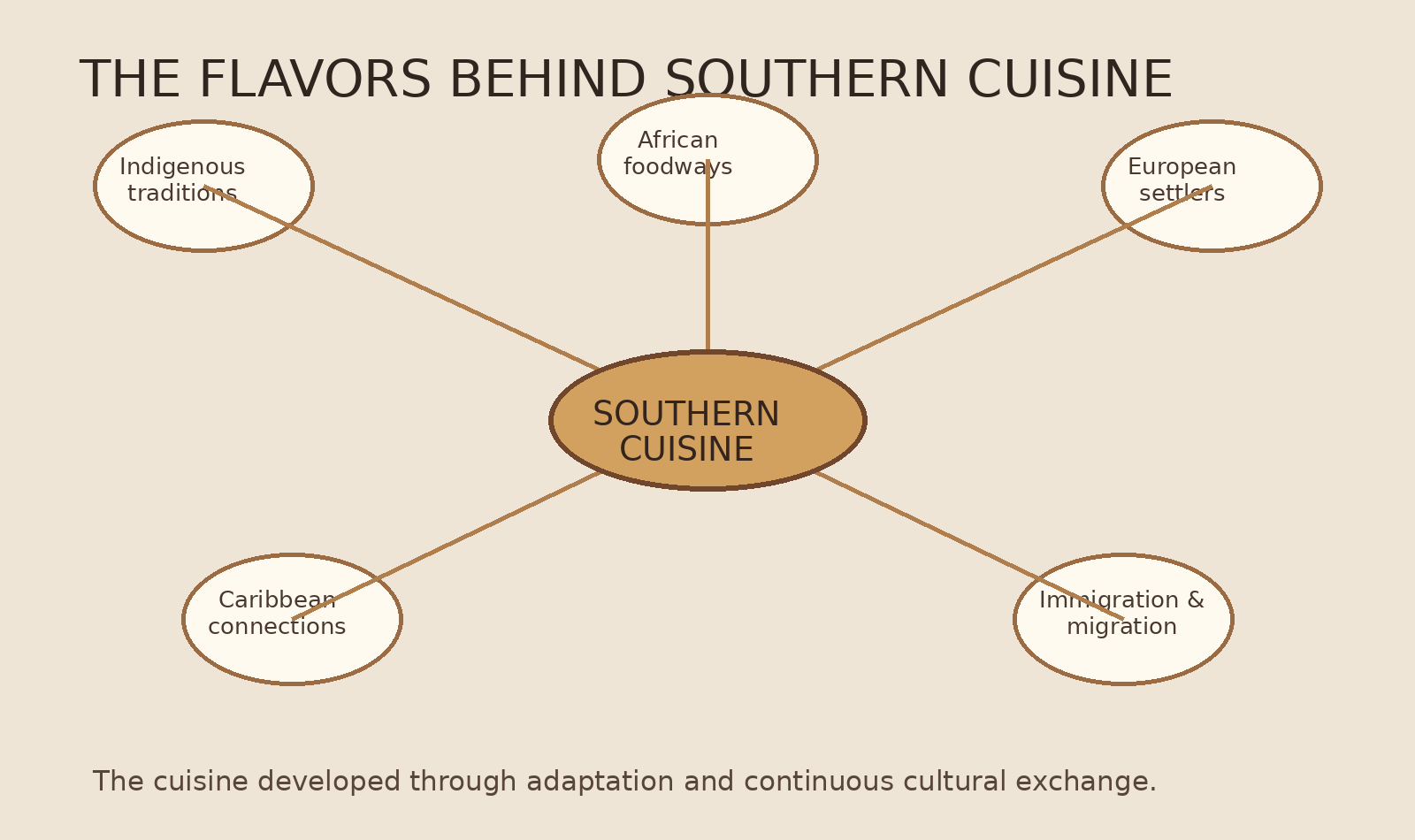
From the Atlantic coast of the Carolinas to the Gulf Coast of Louisiana, from the Mississippi Delta to the mountains of Appalachia and the barbecue traditions of Texas, Southern food changes dramatically from place to place. The differences reflect geography, agriculture, migration, Indigenous foodways, African culinary traditions, European settlement, Caribbean connections and generations of home cooking.
That is what makes Southern American cuisine so fascinating. It is not one fixed cuisine. It is a collection of regional foodways that developed through cultural exchange and adaptation.
What Makes Southern Cuisine Regional?
Food follows geography. Coastal communities have access to seafood, rice-growing areas develop dishes around rice, cattle-producing regions build traditions around beef, and mountain communities often rely on preserved foods, beans, corn, apples and hardy greens.
Southern cuisine also reflects history. The region was shaped by Native American communities, European settlers, enslaved Africans, free Black communities and later waves of immigrants. Smithsonian food historians have documented how African culinary traditions became deeply embedded in Southern cooking, including the use of okra, greens, hot peppers, peanuts and distinctive one-pot dishes.
As a result, two dishes that both belong to the broad category of “Southern food” can have completely different ingredients, techniques and cultural histories.
The Lowcountry: Coastal Carolina and Georgia
Along the coastal areas of South Carolina and Georgia lies the Lowcountry, a region strongly associated with rice, seafood and the culinary traditions of Gullah Geechee communities.
Rice became particularly important because the coastal environment supported rice agriculture, while enslaved Africans brought extensive knowledge of rice cultivation and food preparation from West Africa. Over generations, local ingredients and African traditions combined with European and Native American influences.
One famous Lowcountry dish is shrimp and grits. Grits themselves are made from ground corn, an ingredient with deep Indigenous American roots. Adding shrimp reflects the abundance of seafood along the coast.
Another important tradition is Frogmore stew, a communal dish combining shrimp, sausage, corn and potatoes. Despite its name, it is not actually a stew in the conventional sense. It is commonly boiled in a large pot and served as a social meal.
The coastal South also developed distinctive rice dishes, seafood preparations and vegetable combinations. These foods demonstrate how geography and cultural exchange can create a cuisine that feels unmistakably local.
Charleston and the Gullah Geechee Foodways
The Charleston area is closely connected to Gullah Geechee culinary traditions. These traditions developed among African Americans living in the coastal Carolinas, Georgia and northern Florida.
Food historians frequently emphasize the importance of rice, seafood, okra, beans, greens and one-pot cooking. Many techniques and ingredients have connections to West African foodways, while local conditions introduced new ingredients and combinations.
The Smithsonian's National Museum of African American History and Culture describes the broader Creole Coast as a region where European, African, Caribbean and Native American foodways mixed together.
This history helps explain why Lowcountry food can taste both familiar and distinctive. Rice and seafood may be simple ingredients, but their combinations carry centuries of cultural exchange.
North Carolina and South Carolina Barbecue
Barbecue is perhaps the clearest example of Southern regional identity.
North Carolina is famous for pork barbecue, but even within the state there are major differences. Eastern-style barbecue traditionally emphasizes whole-hog cooking and a thin vinegar-based sauce. The Piedmont region is associated with a sweeter sauce that often includes tomato.
South Carolina adds another major variation: mustard-based barbecue sauce, particularly associated with the state's central region.
These differences did not appear by accident. Smithsonian research traces American barbecue to Caribbean cooking traditions and explains how European influences, local agriculture and migration contributed to regional styles.
The result is a food culture in which sauce can be almost as important as the meat itself.
Virginia and the Southern Piedmont
Virginia occupies an important place in the history of Southern food. Its foodways developed through Indigenous traditions, English colonial influences, African culinary knowledge and later immigrant communities.
Ham became especially important, while corn, beans, greens, apples and preserved foods remained staples.
Virginia also played an important role in the documentation of Southern cooking. Mary Randolph's 1824 cookbook, The Virginia House-Wife, is often considered a landmark in American cookbook history. Recent Smithsonian scholarship emphasizes how Randolph's cooking knowledge was shaped by enslaved cooks and European immigrant traditions.
This is a reminder that written cookbooks do not always tell the whole story of where recipes originated. Much culinary knowledge was passed orally through families and communities, especially by cooks whose names were not recorded.
The Mississippi Delta
The Mississippi Delta has its own distinctive food identity shaped by agriculture, the Mississippi River, Black Southern traditions and connections to neighboring states.
Rice, corn, greens, beans, catfish and pork are important parts of the region's food history. Soul food traditions developed alongside agricultural labor and community life.
Fried catfish is especially associated with the broader Mississippi and Southern river regions. Catfish became an accessible source of protein, while frying offered a practical way to prepare it.
The Delta also demonstrates how Southern food is connected to music, migration and community. Foods traveled with people as African Americans moved from rural Southern communities to cities during the Great Migration. Recipes and cooking techniques traveled with families, helping Southern flavors become part of American urban food culture.
Louisiana: Cajun Country
Louisiana may be the most obvious example of how Southern cuisine can contain several distinct regional identities.
Cajun cuisine developed among descendants of French-speaking Acadians who settled in Louisiana. Their cooking adapted European traditions to the ingredients available in the state's wetlands, rivers and bayous.
Gumbo, jambalaya, boudin and crawfish dishes are among the foods most closely associated with Cajun cooking.
Smithsonian food historians describe Cajun food as a cuisine shaped by adaptation to local ingredients, while also noting that the popularity of Cajun cuisine expanded nationally during the late twentieth century.
A classic Cajun kitchen often emphasizes strong seasoning, rice, sausage, seafood, onions, peppers and celery. But “spicy” alone does not define Cajun cooking. The goal is usually a layered flavor profile rather than heat for its own sake.
New Orleans and Creole Cuisine
New Orleans has a culinary identity that overlaps with Cajun cooking but is not the same thing.
Creole cuisine emerged from the city's complex history of French, Spanish, African, Caribbean, Native American and later immigrant influences. Smithsonian reporting describes gumbo as one of the clearest examples of this cultural blending.
The classic “holy trinity” of onions, celery and bell peppers appears throughout Louisiana cooking. Roux, another important technique, provides a rich base for many dishes.
New Orleans also developed foods that became nationally recognizable: po'boys, red beans and rice, beignets, muffulettas and various seafood dishes.
The city's cuisine is therefore less about one ingredient than about layers of history appearing in the same plate.
The Gulf Coast
Moving along the Gulf Coast, seafood becomes increasingly important.
Shrimp, oysters, crab, fish and other shellfish are common ingredients. Gulf Coast food also demonstrates the influence of Caribbean and Latin American connections.
In Texas, barbecue takes a different direction from the pork-heavy traditions of the Carolinas. Beef brisket is central to Texas barbecue, and German and Central European immigrant influences played an important role in the development of the state's barbecue traditions.
The Smithsonian's National Museum of African American History and Culture similarly identifies Texas beef barbecue as distinct from the pork traditions common across much of the South.
Appalachia: Mountain Foodways
Southern cuisine is not only about coastal areas and barbecue.
The Appalachian region stretches through parts of several states, including Tennessee, Kentucky, Virginia and North Carolina. Its mountainous geography historically limited transportation and encouraged communities to rely on local and preserved foods.
Beans, cornmeal, potatoes, apples, greens, ramps, sorghum and preserved meats became important ingredients.
Appalachian cooking is often associated with resourcefulness. Families preserved summer harvests for winter, made soups and stews from inexpensive ingredients, and used every available part of an animal.
Apple butter, cornbread, biscuits, beans and country ham are examples of foods that reflect this practical relationship with the land.
The region's foodways were also shaped by immigrant communities, including Scots-Irish, German, Irish and other European settlers. Smithsonian research on Appalachian history notes the lasting influence of these migration patterns. citeturn0search1
Soul Food and the Agricultural South
Soul food is often treated as synonymous with Southern food, but the two terms are not interchangeable.
Soul food is deeply connected to African American history and community traditions. It includes foods such as greens, black-eyed peas, cornbread, fried chicken, sweet potatoes, macaroni and cheese, and various stewed or smoked meats.
Its history includes both hardship and creativity. Enslaved cooks worked under brutal conditions while drawing on African, European and Indigenous ingredients and techniques. After emancipation, African American cooks continued to develop and preserve these traditions, often through family kitchens, catering businesses, restaurants and cookbooks.
Smithsonian research emphasizes that African American cooks were central to the development of what became recognizable as Southern cuisine.
Barbecue as a Regional Language
Few foods communicate Southern geography as clearly as barbecue.
Carolina barbecue tends toward pork and vinegar or mustard sauces. Memphis is known for ribs and a sweeter tomato-based style. Texas emphasizes beef, especially brisket. Other regions have their own combinations of meat, smoke, seasoning and sauce.
These distinctions are not merely marketing categories. They developed through agriculture, migration, available wood, local preferences and cultural exchange.
Smithsonian's history of barbecue describes a tradition that traveled from Caribbean roots into the American South and then developed into multiple regional styles.
In this sense, barbecue works almost like a regional language. People can often identify where a style comes from by its meat, smoke, seasoning and sauce.
Why Southern Food Keeps Evolving
Southern cuisine is not frozen in the past.
Chefs and home cooks continue to reinterpret traditional dishes. Some focus on seasonal ingredients and local agriculture. Others combine Southern techniques with global flavors.
The career of Edna Lewis provides an important example. Lewis helped bring national attention to Black Southern cooking and emphasized seasonal ingredients, local foodways and the memories associated with rural Virginia cooking. Her books became influential references for chefs and food writers.
Modern Southern restaurants may therefore serve traditional dishes alongside new interpretations. The cuisine remains recognizable while continuing to change.
The Importance of Regional Identity
Regional food matters because food is one of the clearest ways people express a sense of place.
A bowl of gumbo tells a different story from a plate of North Carolina barbecue. Appalachian beans and cornbread reflect a different landscape from Lowcountry shrimp and grits. Texas brisket belongs to a different barbecue tradition from South Carolina mustard-sauce pork.
Yet these foods also share something.
They demonstrate adaptation.
Southern American cuisine grew from people making meals with what was available, learning from neighbors, preserving family knowledge and adapting recipes to new circumstances.
That is why Southern food cannot be reduced to a single list of dishes.
It is better understood as a map.
Conclusion
Exploring Southern American cuisine means traveling through a collection of regional food cultures rather than discovering one uniform style.
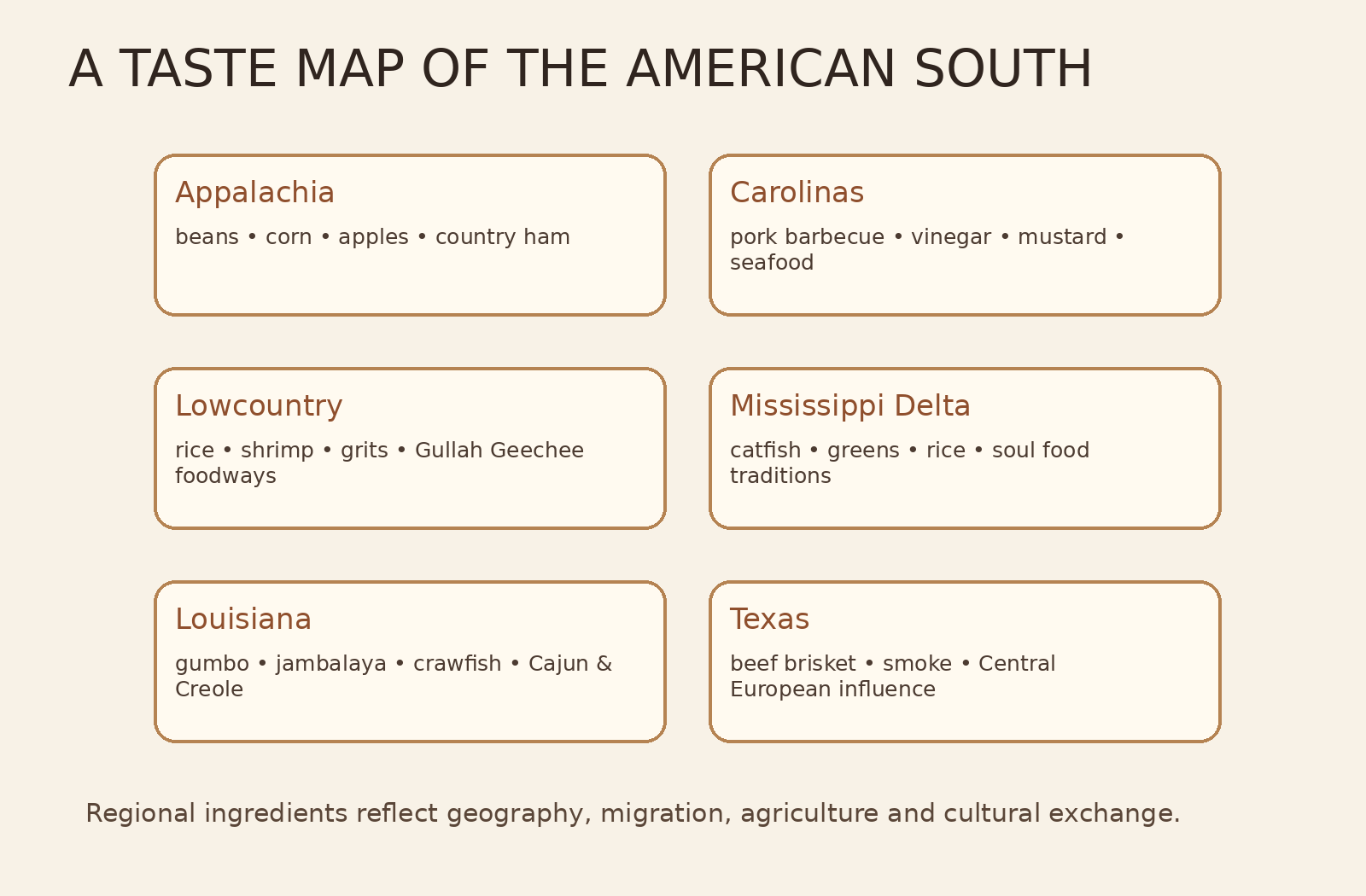
The Lowcountry highlights rice and seafood. The Carolinas are famous for distinct barbecue traditions. Virginia connects early American cookbooks with African, European and Indigenous influences. The Mississippi Delta reflects Black Southern foodways and agricultural history. Louisiana contains both Cajun and Creole traditions. Appalachia emphasizes preservation, local ingredients and mountain resourcefulness. Texas adds its own beef-centered barbecue identity.
Across all of these regions, food tells stories about geography, migration, labor, culture and memory.
The most important lesson is that Southern cuisine was never created by one group or one generation. It developed through continual interaction among Native American, African, European, Caribbean and immigrant traditions.
That ongoing exchange is what keeps Southern food alive.
The next time you sit down to a plate of barbecue, a bowl of gumbo, shrimp and grits, fried catfish or Appalachian beans, you are not simply eating a regional specialty.
You are tasting a piece of American history.
Sources and Further Reading
- Smithsonian Magazine — The Evolution of American Barbecue.
- Smithsonian Magazine — Five Quintessential Cajun Foods.
- Smithsonian Magazine — Gumbo: The Superest Bowl of All?
- Smithsonian Magazine — How Enslaved Chefs Helped Shape American Cuisine.
- Smithsonian Magazine — Who Was Edna Lewis?
- Smithsonian Magazine — There Was No American Regional Cuisine Until One ‘Virginia Housewife’ Thought to Compile a Diverse Collection of Recipes.
Leave a Reply